Why Is CELPIP Speaking So Hard? What the Clock and the Rating Really Ask
CELPIP Speaking feels hard because it tests more than your English. Most tasks give you 30 seconds to plan and 60 or 90 seconds to speak, the eight scored tasks each ask for a different kind of answer, and every answer is rated on four things at once: your ideas, your words, how easy you are to listen to, and whether you did what the task asked. Most people who struggle are not short of English. They are short of practice under that clock.
Each of those pressures can be practised on its own, once you know which one is squeezing you. (Spokaro is not affiliated with Paragon Testing Enterprises, the maker of the CELPIP test; every timing below comes from its published format and study pack, linked at the end.)
Is CELPIP Speaking hard? The short answer
It is hard in a specific way. The speaking section has 15 minutes allotted, and the official study pack says it takes about 15 to 20 minutes to complete. Inside that window sit one optional practice task and eight scored tasks. Add up the speaking time of the eight scored tasks and you get about nine minutes of you talking, split into short bursts of one minute or a minute and a half.
Nine minutes is not long. The difficulty is that each burst starts cold, with a new situation you have never seen, and ends when the timer says so, not when you finish your thought. A strong speaker who has never practised with a timer can lose more marks to the clock than to grammar.
So when people say the speaking test is hard, they usually mean one of five things. Here they are, one by one.
Thirty seconds to plan is the first squeeze
Six of the eight scored tasks (Tasks 1, 2, 3, 4, 7 and 8) give you 30 seconds to prepare. Thirty seconds is enough to pick a direction and two or three points. It is not enough to write sentences, and that is where many people lose the first round: they spend the planning time composing an opening line, then reach the second point with nothing ready.
The fix is a habit, not a talent. Use the planning seconds for a skeleton: one word for your main point, one word for each supporting idea, one word for the example. If you can say your plan in three or four words, you can talk from it for a full minute.
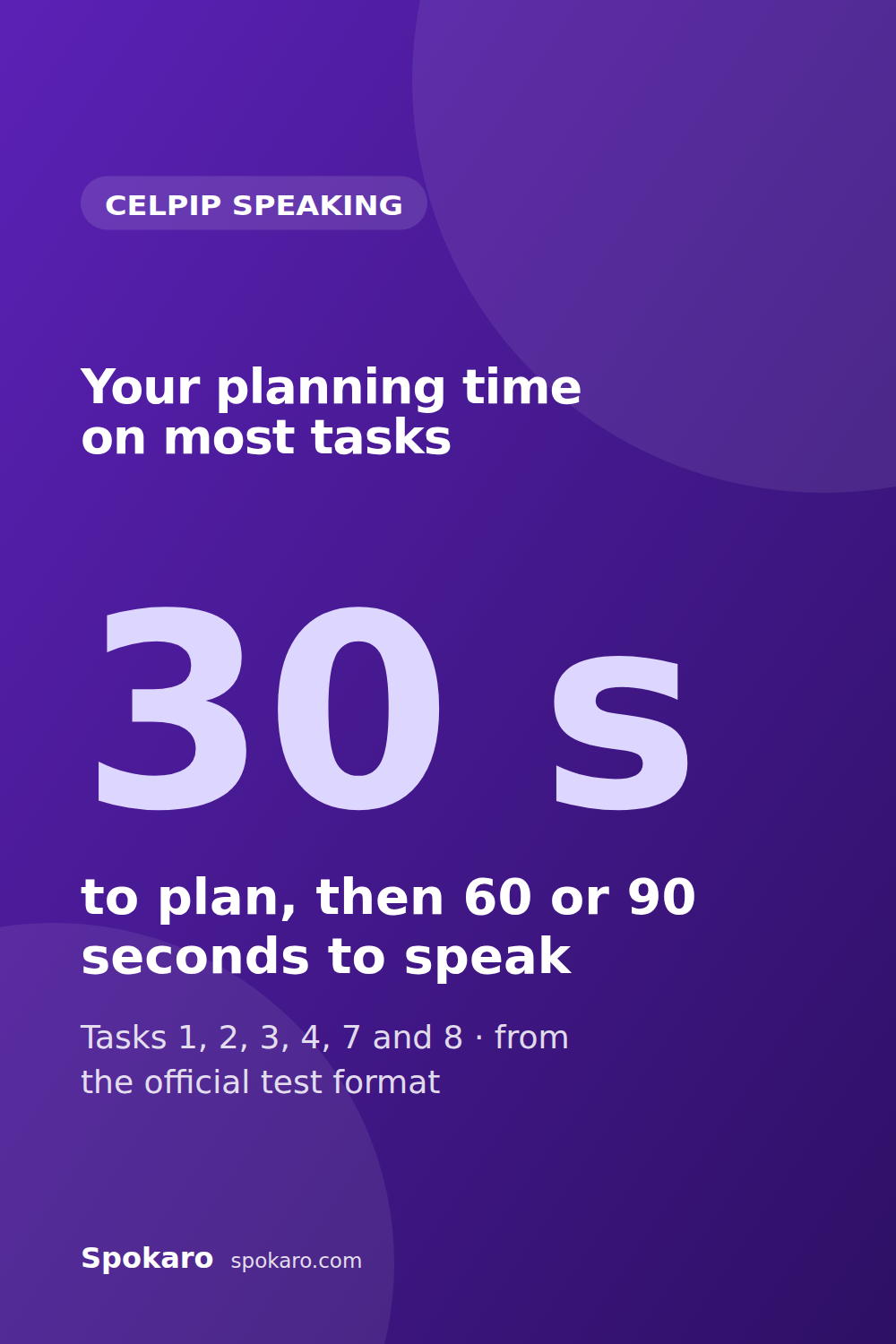
The speaking time is the second half of the squeeze. Tasks 1 and 7 run for 90 seconds; the others run for 60. A 90-second answer needs more than one idea, and a 60-second answer punishes a slow start. Both reward knowing, before the test, roughly how much you can say in each length.
Eight tasks, eight different kinds of answer
The second thing that makes the test hard is variety. You are not asked the same kind of question eight times. One task wants advice, the next a story from your past, then a description, a prediction, an argument, a tactful explanation, an opinion, and finally a description for someone who cannot see what you see. Each one has its own shape, and switching shapes every minute is tiring.
Here is the whole test at a glance, with the planning and speaking time for each task as the official format lists them:
| Task | What it asks | Plan | Speak |
|---|---|---|---|
| Practice | A warm-up, not scored; optional | 30 s | 60 s |
| 1 | Giving Advice: help someone choose or get ready | 30 s | 90 s |
| 2 | Talking about a Personal Experience: a story from your past | 30 s | 60 s |
| 3 | Describing a Scene: what is going on in a picture | 30 s | 60 s |
| 4 | Making Predictions: the same picture, what comes next | 30 s | 60 s |
| 5, part 1 | Comparing and Persuading: pick one of two options, silently | 60 s | none |
| 5, part 2 | Comparing and Persuading: argue your pick is the better one | 60 s | 60 s |
| 6 | Dealing with a Difficult Situation: explain a decision, tactfully | 60 s | 60 s |
| 7 | Expressing Opinions: give and defend your view | 30 s | 90 s |
| 8 | Describing an Unusual Situation: describe a picture to someone who cannot see it | 30 s | 60 s |
Notice the pattern: the clocks are short everywhere, but the job changes every time. That is why practising only one task type, or only answering questions in your head, leaves gaps that show up on test day. If you want to feel the timing for yourself, every task on the practice page runs on the same clock as the table above.
Tasks 5 and 6 change the rules halfway
Most tasks follow the same rhythm: read, plan, speak. Tasks 5 and 6 break it, and many test takers name one of them when asked about the hardest part.
Task 5 has two parts. In Part 1 you get 60 seconds to choose between two options, and you do not speak at all. In Part 2 you get another 60 seconds to prepare, then 60 seconds to argue that your choice is better than the one the other person prefers. The trap is spending Part 1 only on choosing. The 60 silent seconds are also the time to notice what makes your option stronger, so that Part 2 starts with reasons rather than with a search for them.
Task 6 gives you more time to plan (60 seconds) and asks for more care. You explain a decision to someone, often someone who will not like it: a friend, a family member, someone you know a little, or a customer. The rating includes tone, so the content alone is not enough. A clear decision delivered bluntly and a kind answer that never says what you decided can both fall short.
A habit for Tasks 5 and 6
Before you speak, name your choice and your top reason in one breath. Then spend the rest of the minute on why, with one concrete detail. In Task 6, add one sentence that shows you understand how the other person feels.
Three tasks hang on a picture
Tasks 3, 4 and 8 start from an image. Task 3 asks you to describe a scene; Task 4 keeps the same picture and asks you to predict where the scene goes from there; Task 8 shows something unusual that you describe to a person who cannot see it.
Pictures are hard for a reason people rarely expect: they pull you into listing. "There is a man. There is a dog. There is a tree." A list has words but no shape. The answers that read well give the picture an order, from the big picture to the details, or from left to right, and they connect the details to what is happening.
Task 4 adds a second difficulty: predictions need grammar for the future and for likelihood ("will probably", "might", "is about to"). Task 8 adds a third: your listener cannot see the picture, so size, shape, colour and position matter more than in Task 3. Practising all three together is worth it, because one picture can train all three skills.
Every answer is rated on four things at once
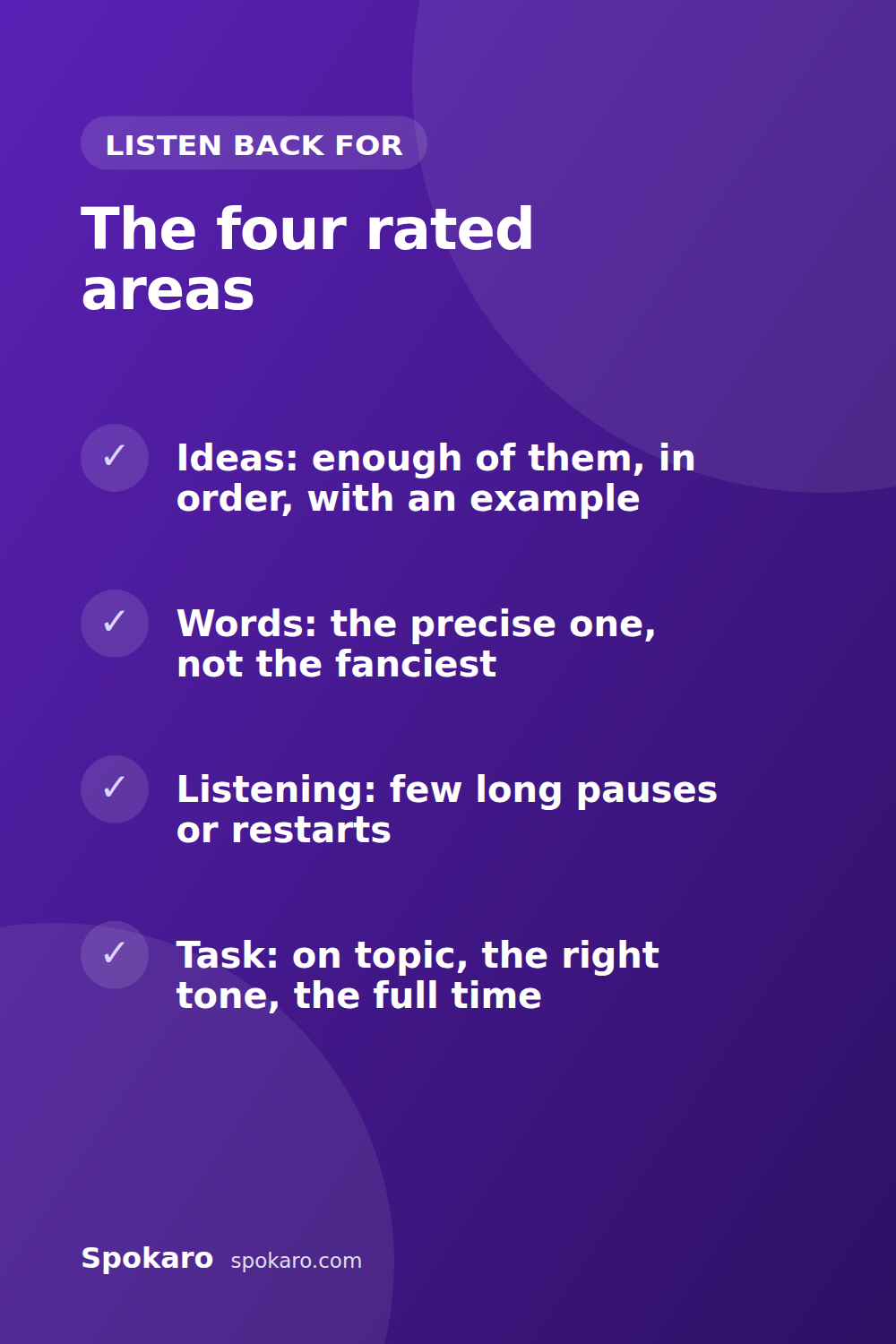
The official study pack describes four rating areas. Knowing them takes some of the mystery out of the score, because it shows that a fluent answer can still lose marks, and a hesitant one can still earn them.
- Content/Coherence: how many ideas you give, how good they are, how well they are organized, and whether you support them with examples and details.
- Vocabulary: choosing the right words, using them in a natural way, the range you show, and how precise you are.
- Listenability: your rhythm, pronunciation and intonation; how often you pause, fill gaps or correct yourself; your grammar; and how varied your sentences are.
- Task Fulfillment: whether you stayed relevant, covered everything the task asked, used a suitable tone, and filled the time.
Four areas at once is the heart of why the test feels hard. While you are thinking about your next idea, you are also choosing words, keeping your pace, and watching the clock. Practice makes some of that automatic, so that your attention is free for the ideas.
What is the hardest part of CELPIP Speaking?
There is no single hardest task for everyone, and that is the honest answer. Where people struggle depends on what they already do well. Still, the same few patterns come up again and again, and each one points at one of the four rated areas:
- Running out of things to say before the time ends, most often in the 90-second tasks (1 and 7). That is a Content/Coherence problem: one idea, stretched.
- Running out of time with the main point still unsaid. That is planning: the opening took too long, and Task Fulfillment suffers.
- Long pauses and restarts while searching for a word. Listenability counts pauses and self-correction, so a simpler word said smoothly usually reads better.
- The wrong tone in Task 6, either too blunt or too vague. Tone sits inside Task Fulfillment.
- Listing instead of describing in Tasks 3 and 8, which costs organization.
If one of these sounds like you, that is your hardest part, whatever the forums say. The fastest progress usually comes from fixing your own most frequent problem, not from studying the task other people find hardest.
Is it hard to get a 7 in CELPIP Speaking?
A 7 on the CELPIP scale lines up with CLB 7 and with B2 on the European (CEFR) scale. The official description calls it adequate ability in settings that are somewhat demanding: social, educational or work situations a step beyond everyday small talk.
Whether it is hard depends entirely on where you start, and no one can promise a level. What helps is measuring before you guess: answer a few tasks under the real timing, listen back, and see which of the four areas is pulling you down. Spokaro's practice gives an estimate of how an answer reads, always as a band two levels wide (for example, "about CLB 7 to 8"), and never as your official result. Treat any practice score, ours included, as a direction, not a prediction.
How to practise the parts that feel hardest
Practice works best when it copies the test's pressure and then gives you something specific to fix. A simple routine:
- Always use the real clock. 30 or 60 seconds to plan, 60 or 90 to speak, as in the table above. Practice without a timer trains a different skill.
- Plan in key words, not sentences. Three or four words on paper (or in your head) are a plan you can talk from.
- Record every answer and listen back once. Use the four-area checklist: ideas, words, how it sounds, and the task.
- Fix one thing, then repeat the same task once. Repeating it right away shows you whether the fix worked.
- Rotate the task types. Give extra turns to the ones on your hardest-part list, but keep all eight in your week.
- Run the whole set back to back once a week. Eight tasks in a row is a different kind of tired; the free mock test does exactly that, with an estimated band at the end.
Short daily sessions beat one long one. Two or three timed answers a day, each followed by one honest listen, build the planning habit faster than an hour of reading model answers. Model answers show you what a good answer looks like; only timed practice teaches you to produce one.
One more tip: keep a short note of what went wrong in each attempt, in a few words. After a week, the note tells you your real hardest part better than any article can.
Questions people ask about CELPIP Speaking
Questions people ask
Is CELPIP speaking difficult?
It is demanding in a specific way: short planning time (30 seconds on most tasks), short speaking time (60 or 90 seconds), eight different task types, and four rated areas at once. With timed practice, most of that pressure becomes familiar.
How long is CELPIP Speaking?
The official format gives the speaking section 15 minutes; the official study pack says it takes about 15 to 20 minutes to complete. That includes an optional practice task and eight scored tasks.
How do I improve my CELPIP speaking?
Practise with the real timing, plan in key words, record your answers and listen back against the four rated areas (content and organization, vocabulary, listenability, task fulfillment), then fix one thing at a time and repeat the task.
Can I prepare for CELPIP in 3 days?
Three days is enough to learn the format, the timings and a planning habit, which already removes some surprises. It is rarely enough to change how fluently you speak, so start earlier if you can and use the time for timed practice.
Sources
Keep reading
Is CELPIP Speaking Harder Than IELTS? What Changes for the Speaker
Is CELPIP Speaking harder than IELTS? Neither is harder on paper. What changes for you: the format, the timer, what raters judge and the band you need.
Is CELPIP Speaking Marked by AI? Who Really Rates Your Answers
Is CELPIP Speaking marked by AI? No: three to five trained raters score it, and only Writing uses an AI-human system. What that means for your practice.
CLB 9 in CELPIP Speaking: What Level 9 Answers Do That Level 8 Answers Don't
CLB 9 in CELPIP Speaking, read from the test maker's own rater notes: what separates its Level 8 and Level 9 sample answers, and how to practise for it.