Scores
CLB 9 in CELPIP Speaking: What Level 9 Answers Do That Level 8 Answers Don't
Level 9 in CELPIP Speaking (CLB 9) isn't a flawless answer. In the test maker's own sample answers, the Level 9 responses still have ums, restarts and the odd wrong word. What lifts them above the Level 8 answers is depth: one or two ideas pushed further with real details, everyday phrases used precisely, slips that don't get in the listener's way, and an answer aimed at the person the task names. The Level 8 notes keep asking for the same thing. More development. More detail.
The test maker's CELPIP Speaking Pro: Target 9+ Study Pack shows this pair by pair, and its rater notes are worth reading one rating area at a time. Spokaro is not affiliated with Paragon Testing Enterprises, the maker of the CELPIP test, and no practice tool can promise you a level. What the notes can do is show you where the line between an 8 and a 9 tends to sit.
CLB 9 in CELPIP Speaking: the short answer
The study pack holds 16 sample answers, two for each of the eight scored tasks, each with a short analysis in the four areas raters use. Seven of the eight tasks have one answer rated Level 8 and one rated Level 9. Task 4 has a Level 9 and a Level 12. That's as close to a side-by-side as the test maker publishes, and it's worth reading slowly.
Here's what the pairs say, in one list:
- Content/Coherence: Level 8 answers name ideas. Level 9 answers develop them, with details, examples and links between them.
- Vocabulary: Level 9 answers use common words and phrases precisely and naturally. They don't need rare words.
- Listenability: both levels hesitate and correct themselves. At Level 9 it usually costs less, and the grammar holds a few longer sentences together.
- Task Fulfillment: both levels miss small things, like a closing or talking to the right person. The full time, a fitting tone and relevant content matter at every level.
If you only change one habit, make it the first one. For each idea you say, add the because and a concrete example before you move on.
What CELPIP Level 9 means on the score chart
CELPIP reports each skill as a level from 12 down to 0. On the official Test Format & Scoring page, CELPIP Level 9 lines up with CLB 9 and with B2 on the European CEFR scale, the same B2 band as Levels 7 and 8. Paragon describes Level 9 as effective proficiency in some high-stakes social, educational or workplace contexts. Level 8 is good proficiency in more demanding ones.
Your speaking level isn't the score of one task. The study pack explains that each response is scored separately on four dimensions, and your level comes from all eight tasks together. So there's more than one road to a 9. A weak Task 3 can sit beside a strong Task 7, and the level is built from the whole set.
The pack's Level 9 descriptors read like this, in short. At Level 9 a speaker can support ideas with moderately complex reasons, use common or context-specific words (plus some idioms), handle some complex grammar, speak with mostly fluent rhythm and intonation, and adjust tone to different listeners. Its Level 9 profile adds that mistakes in grammar, words and pronunciation rarely make the meaning hard to follow. Notice the word rarely. Not never.
Level 9 answers still have ums, slips and restarts
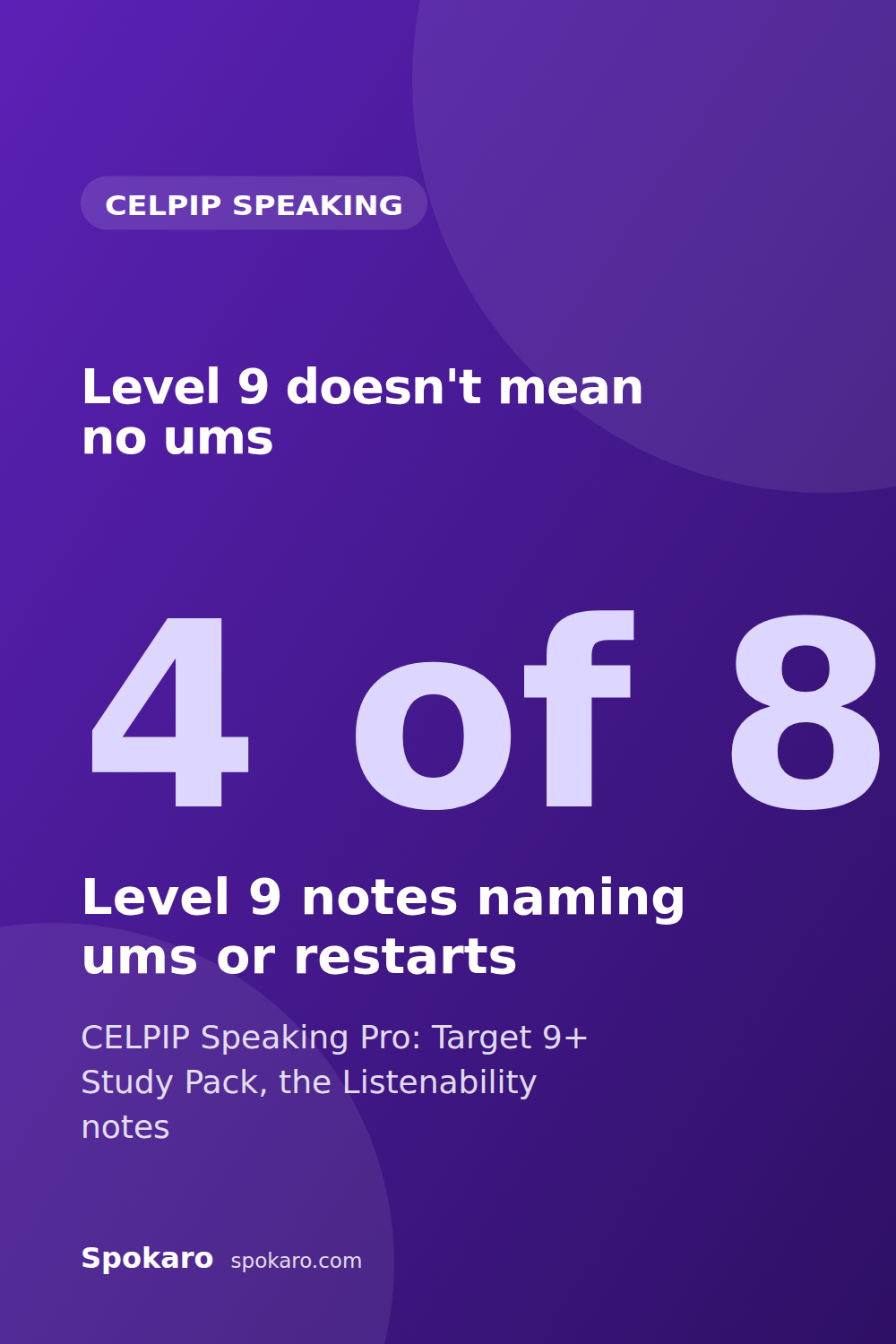
This is the part most test takers don't expect. Read the Level 9 transcripts and you'll find plenty of uh and um. In four of the eight Level 9 analyses, the Listenability note still mentions hesitations, interjections or self-corrections. One Level 9 Task 6 answer is told outright that its interjections and self-corrections interfere with flow. It still got a 9, on the strength of the rest.
Why does that matter for your prep? Because a lot of practice time goes into scrubbing every um out of an answer, and the notes suggest that isn't where the 9 lives. A filler costs you when there are so many that the listener loses the thread. A single “uh” before a good detail costs you almost nothing. Spend the time on the detail.
Same with mistakes you catch yourself. One Level 9 Task 2 answer mixes up two expressions, fixes it mid-sentence, and the note simply records that it corrected the error. A quick, clean fix reads as control. Three restarts in a row read as struggle.
Content: one idea developed beats three ideas listed
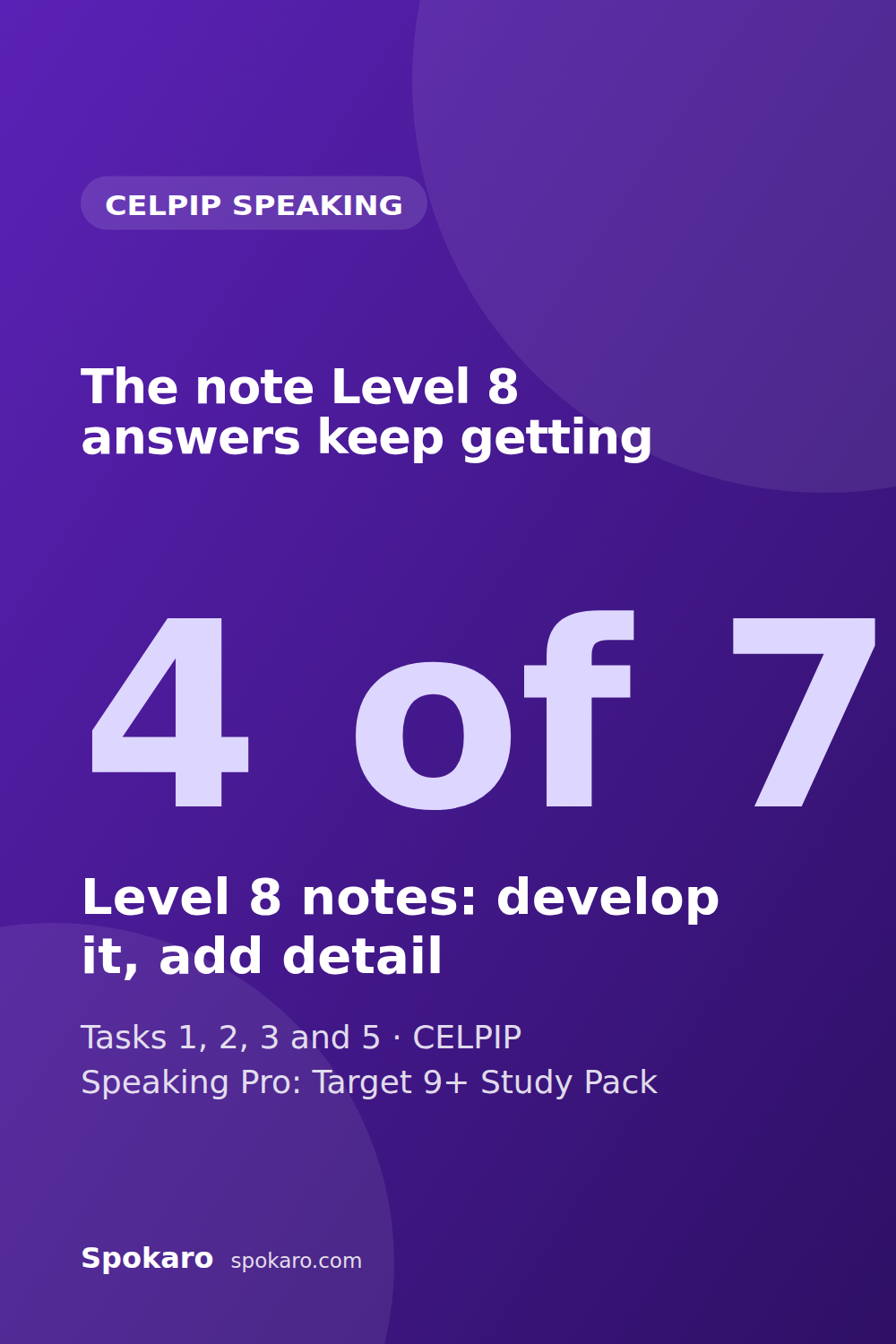
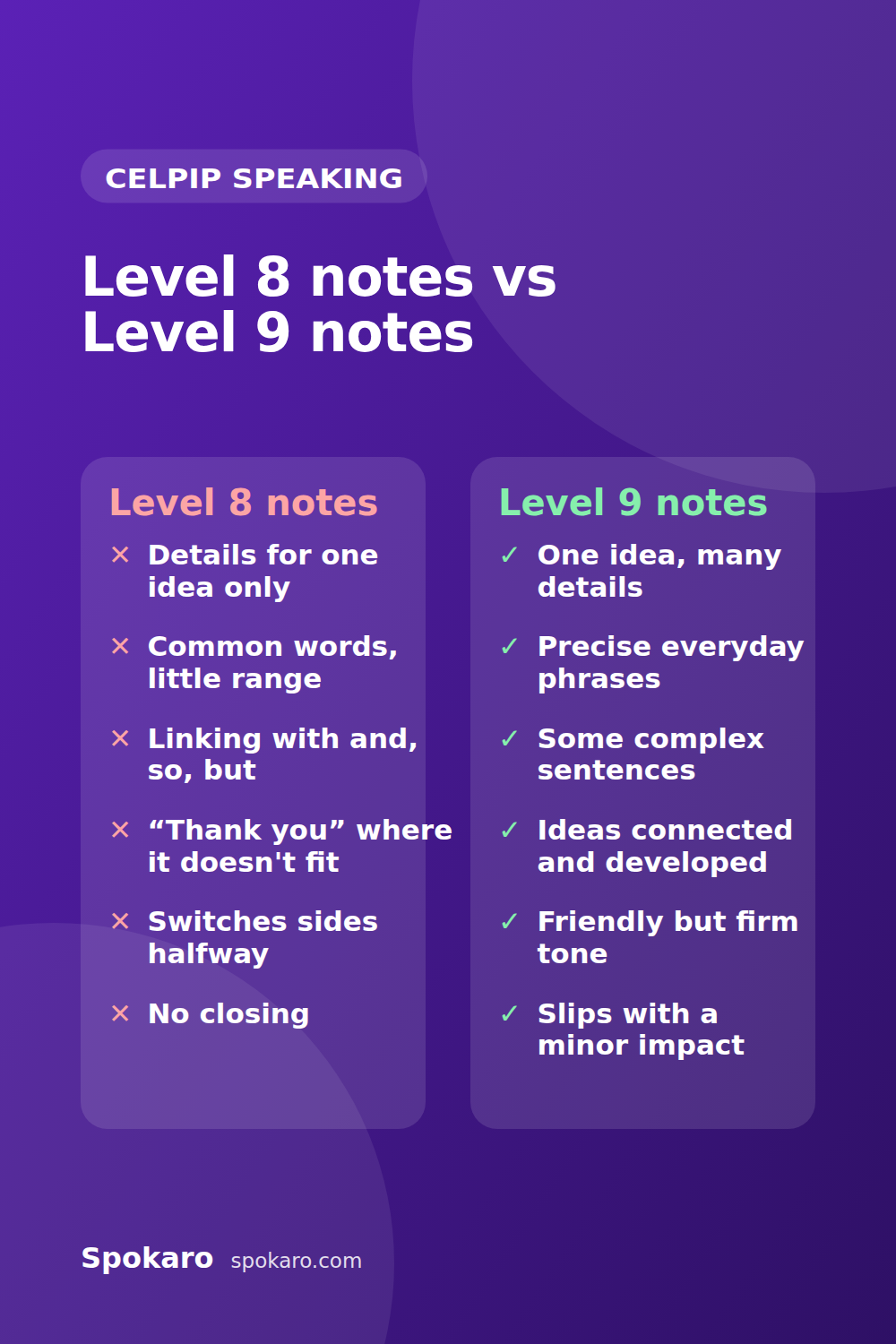
Content/Coherence is where the gap between the pairs is clearest. In four of the seven Level 8 analyses, the note asks for more development or more detail. The Task 2 note says it in so many words: more development and more specific details are needed to reach Level 9+. The Task 1 note finds details on the first idea and none on the others. The Task 5 note says examples or details would improve the content.
Now look at the Level 9 side. The Level 9 Task 1 answer has only one main idea, a part-time job, and the note says so. It was still rated above the Level 8 Task 1 answer, which had several ideas, because that one idea comes with campus jobs, the immigration rules, references and an offer to pass on a resume. The Level 9 Task 5 answer is praised for connecting its ideas and developing them, and its coherence is called strong.
Counting ideas isn't the trick, then. Three reasons with nothing under them sound like a list. One reason with a why, an example and a consequence sounds like a person thinking.
- Listed, to a friend asking whether to take an evening class: “You should take it. It's good for your career, it's cheap, and you'll meet people.”
- Developed, to the same friend: “Take it. The class runs Tuesday nights, so it won't clash with your weekend shifts, and the certificate is the exact one your manager mentioned last month. Six weeks from now you could be the person they ask first.”
The second version has one main reason. It's also the one a rater can follow, picture and believe.
Vocabulary: precise everyday phrases, not rare words
Look at the words the Level 9 notes single out as strengths: phrases like “forward your resume”, “field of work”, “check them out” and “going at it for hours”. None of them is rare. They're the phrases a fluent speaker reaches for without thinking, used in exactly the right spot.
The Level 8 notes go the other way. Six of the seven name awkward, imprecise or inaccurate word use, or ask for a wider range to make the meaning sharper. The seventh says the speaker struggles to describe the overall scene. The fix those notes point to isn't a list of impressive words. It's fewer vague ones. “Really good”, “a good thing” and “some stuff” are the kind of words that cost precision, and the notes catch them even at Level 9.
There's a warning in the Level 9 Task 6 answer too. It reaches for formal linking words like “otherwise” and “nevertheless”, and the note says it uses them incorrectly. A fancy word in the wrong place does more harm than a plain one in the right place. When you're not sure, say the simple version.
The Level 12 answer in the pack shows where this goes at the top: “in terms of”, “I would imagine”, “quite stern”. Still everyday English. Just chosen with care.
Listenability: when self-corrections start to cost you
Listenability covers rhythm, pronunciation and intonation, pauses and self-corrections, grammar, and variety of sentence structure. Most answers at both levels get credit for clear pronunciation, so that isn't usually the dividing line. Two things are.
How much the hesitations cost. Level 8 notes say interjections and self-corrections “sometimes” or “occasionally” interfere with flow. Two Level 9 notes call their impact minor or minimal, words no Level 8 note uses. Same habit, smaller dose.
Whether some longer sentences hold together. Level 8 notes mention mostly simple sentences, and errors like a plural noun after “this”. Level 9 notes keep pointing at a complex sentence that worked: an if clause, or a sentence joined with a word like because or when. You don't need many. One or two well-built longer sentences per answer show the rater you have the range.
One more note worth knowing. A Level 9 Task 4 answer is told that its quick pace sometimes makes it hard to follow. The Level 12 answer is fast too, and there the note says the speed causes no problem because the pronunciation and intonation are excellent. So speed isn't the goal. Clear is the goal, and fast is only fine once clear is solid.
Task Fulfillment: small misses at both levels
Task Fulfillment asks whether you followed the instructions, in a fitting tone, for the right length. It's also where Level 9 answers lose easy marks. In four of the eight Level 9 analyses, the note names a Task Fulfillment miss: a picture described to nobody in particular, a closing that could be better, an answer about a choice that never speaks to the customers it was meant for, and an opinion with no closing at all.
The Level 8 misses are the same kind of thing, a little bigger. A “Thank you” at the end of a Task 6 conversation, which the note calls awkward for that context. A Task 7 answer that argues yes, then drifts toward no. A Task 8 phone call with no closing and some details nobody needed. A Task 3 answer whose rate of speech hurt its completeness.
These are habits, not English problems, and that's good news. You can fix them in a week. Before you record any answer, check three things: who you're talking to, which side you're on, and how you'll finish. Then say your first and last sentence to that person, by name if the task gives one.
Our CELPIP speaking template lays out an answer shape for each of the eight tasks, with the openings and closings that fit each one.
A weekly practice routine built from the rater notes

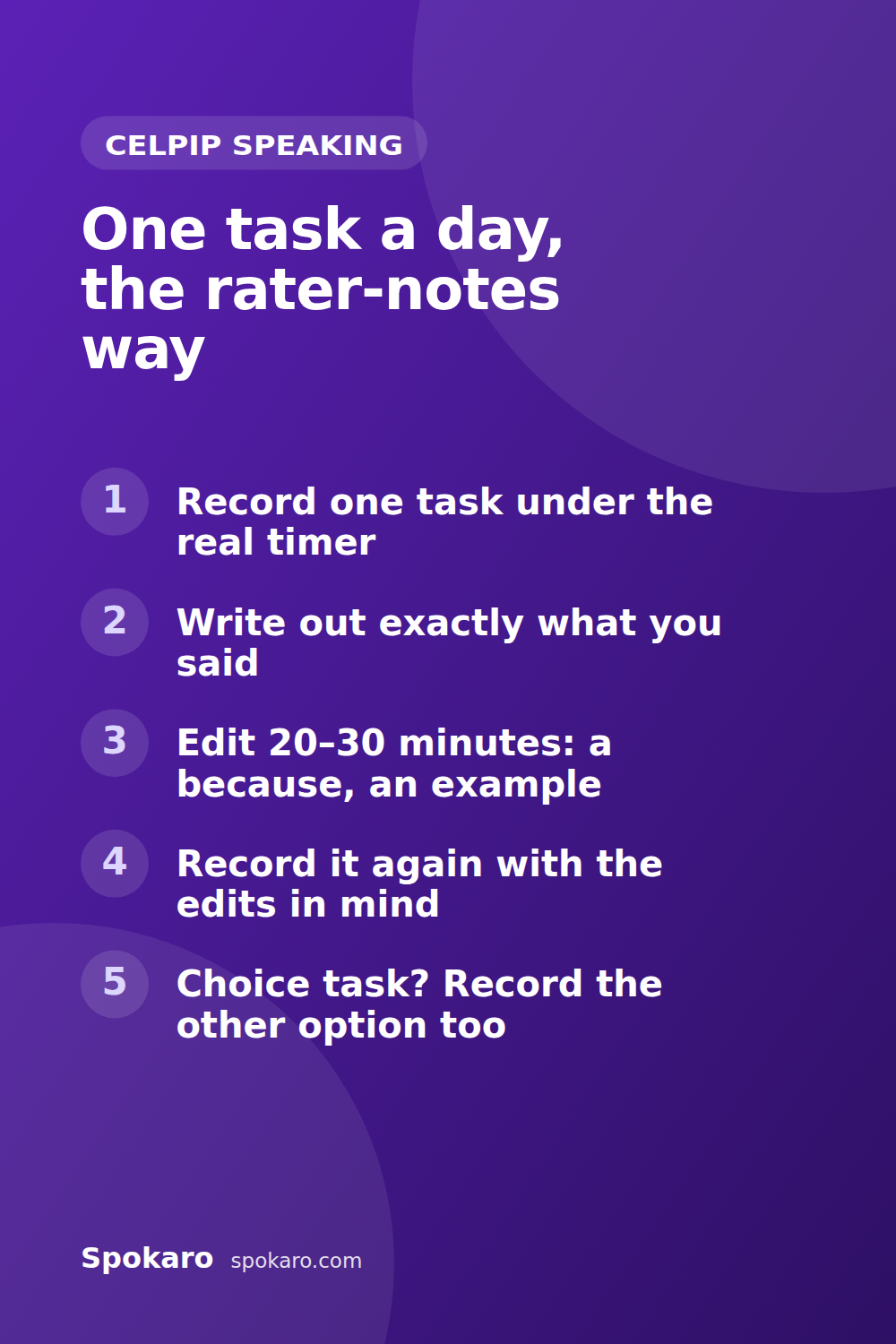
The study pack suggests its own way to practise, and it's more specific than most tip lists. Record your answer to a practice question. Write out what you said. Spend 20 to 30 minutes editing that transcript to make it stronger, the way the notes would: better transitions, more precise words, more specific details, a longer sentence or two. Then record it again. For the tasks with a choice, record one answer for each option. For Task 7, answer yes, reset the timer, and answer no.
The pack also suggests giving yourself more prep time than the real test at first, then cutting it down step by step. That's a kinder way to build the habit of developing ideas than starting cold at 30 seconds.
Here's a week that fits around a job:
- Monday and Tuesday: Tasks 1 and 2. In the edit, check that every idea has a detail under it.
- Wednesday: Tasks 3 and 4, the picture pair. Say who you're talking to in the first line.
- Thursday: Tasks 5 and 6, both options each. Check your closing fits the person.
- Friday: Tasks 7 and 8. One side only in Task 7, and a real goodbye in Task 8.
- Weekend: all eight back to back, then listen to one answer and mark every vague word.
When you edit, keep the rater's four questions next to you. How well are your ideas organized and developed? What's the range of your vocabulary, and do you use it naturally? How easy is the answer to listen to? Did you follow the instructions in a fitting tone? If an edit doesn't answer one of those, it's probably polish you can skip.
If you'd like a second opinion between your own reviews, the Spokaro practice room runs each task with its real prep and speaking times. Its AI gives an estimate on the same four dimensions, always as a band two levels wide like “about CLB 7–8”, never one number and never your official result. The free mock test runs the scored tasks back to back and ends with the three things to fix first.
Questions people ask
How to score 9 in CELPIP Speaking?
Nobody can promise a level, but the official sample answers point the same way. Develop each idea with a reason and a concrete example instead of listing many ideas, use everyday phrases precisely, build one or two longer sentences that hold together, speak to the person the task names, and finish with a closing that fits. Practise by recording, writing out and editing your answers, then recording again.
Is it easy to reach CLB 9 in CELPIP Speaking?
It depends on where you start. Paragon describes Level 9 as effective proficiency in some high-stakes social, educational or workplace contexts. The study pack's Level 9 answers aren't perfect: they still have hesitations and some word-choice slips. The difference from Level 8 is mostly more developed ideas and more precise language, which practice can build.
What is CLB 9 for CELPIP?
CELPIP reports each skill as a level from 12 down to 0, and CELPIP Level 9 is the same as CLB 9, the Canadian Language Benchmark. On the European scale it sits at B2, like Levels 7 and 8. Your speaking level comes from all eight tasks, each scored on Content/Coherence, Vocabulary, Listenability and Task Fulfillment.
Sources
- Paragon Testing Enterprises, CELPIP Speaking Pro: Target 9+ Study Pack (2020): the key strategies, the 16 sample answers and their analyses, the Level 9 descriptors (archived copy, read 2026-11-07)
- Paragon Testing Enterprises, Test Format & Scoring: the levels, CLB and CEFR equivalents and descriptors
- Paragon Testing Enterprises, Test Format & Scoring (archived copy)
Keep reading
CELPIP Speaking Template: 8 Answer Shapes Built From the Official Rater Notes
A CELPIP speaking template for all 8 tasks, built from the test maker's own strategies and rater notes: what a long intro or an empty signpost costs.
Is CELPIP Speaking Marked by AI? Who Really Rates Your Answers
Is CELPIP Speaking marked by AI? No: three to five trained raters score it, and only Writing uses an AI-human system. What that means for your practice.
Is CELPIP Speaking Harder Than IELTS? What Changes for the Speaker
Is CELPIP Speaking harder than IELTS? Neither is harder on paper. What changes for you: the format, the timer, what raters judge and the band you need.