Is CELPIP Speaking Harder Than IELTS? What Changes for the Speaker

Is CELPIP Speaking harder than IELTS Speaking? Neither one is harder across the board, and both lead to the same Canadian Language Benchmark (CLB) levels for immigration. What changes is the kind of hard. CELPIP puts you alone with a screen, a headset and a countdown for eight short tasks. IELTS puts you across the table from an examiner for an 11 to 14 minute conversation. Most people find one of those clearly easier than the other, and it usually has more to do with how they handle pressure than with their English.
Below, the two speaking tests sit side by side from the speaker's chair: what you do, how much of it is scored, how long you get to plan, what the raters listen for, and the score each test asks for at the same CLB level. Spokaro is not affiliated with Paragon Testing Enterprises, the maker of the CELPIP test, or with the organizations that own IELTS.
Is CELPIP Speaking harder than IELTS? The short answer
On paper, no. Canada's immigration department (IRCC) accepts both for Express Entry, as long as you take the CELPIP-General test or the IELTS General Training option, and it converts each result to the same CLB scale. A CELPIP Speaking level converts straight across: Level 7 is CLB 7, Level 9 is CLB 9. IELTS Speaking bands climb their own ladder, so 6.0 is CLB 7 and 7.0 is CLB 9.
In the room, though, the two feel nothing alike. The quick version:
- CELPIP Speaking tends to suit you if you tense up when someone watches you, you like knowing exactly what each task will ask, and you can think fast on a short timer.
- IELTS Speaking tends to suit you if a real listener helps you relax, you're better in conversation than in a monologue, and you'd rather plan one longer talk with a pencil in hand.
Neither list is about your level. A strong speaker can still lose points in a format that fights how they think, so it's worth picking the one that fits you before you book.
A screen and a headset vs an examiner across the table
CELPIP Speaking is computer-delivered from start to finish. You read each task on the screen, a timer counts down your preparation time, and then the recording starts on its own. Nobody reacts while you talk. Your recordings are rated later by people: the official CELPIP results page says each speaking performance is rated by three to five trained raters, each working alone.
IELTS Speaking is a face-to-face interview with a certificated examiner, and it's recorded too. The examiner asks the questions, keeps the time and decides when each part ends. The official IELTS format page sets it at 11 to 14 minutes in three parts:
- Part 1, 4 to 5 minutes: short questions on familiar topics like home, family, work, studies or interests.
- Part 2, 3 to 4 minutes: a task card, one minute to prepare with a pencil and paper, then a talk of up to two minutes. The examiner may ask one or two questions after it.
- Part 3, 4 to 5 minutes: a discussion of more general, abstract questions linked to the Part 2 topic.
That one difference changes a lot. In IELTS, a friendly face can pull you along, and a follow-up question can rescue an answer that started badly. It can also throw you if the examiner's neutral expression reads as boredom. In CELPIP nothing rescues you mid-answer, but nothing reacts to you either. Some people find that a relief. Others find talking to a silent screen strange for the first few tasks, and that's worth practising before test day.
How much of your speaking actually gets scored
Add up the official CELPIP timings and you get a number most comparisons skip. The eight scored tasks give you 9 minutes of speaking time in total: 90 seconds each for Task 1 (Giving Advice) and Task 7 (Expressing Opinions), and 60 seconds for each of the other six. Spread across those tasks you get 6 minutes of preparation, mostly in 30-second slices. There's also an optional practice task at the start, and nobody listens to it.
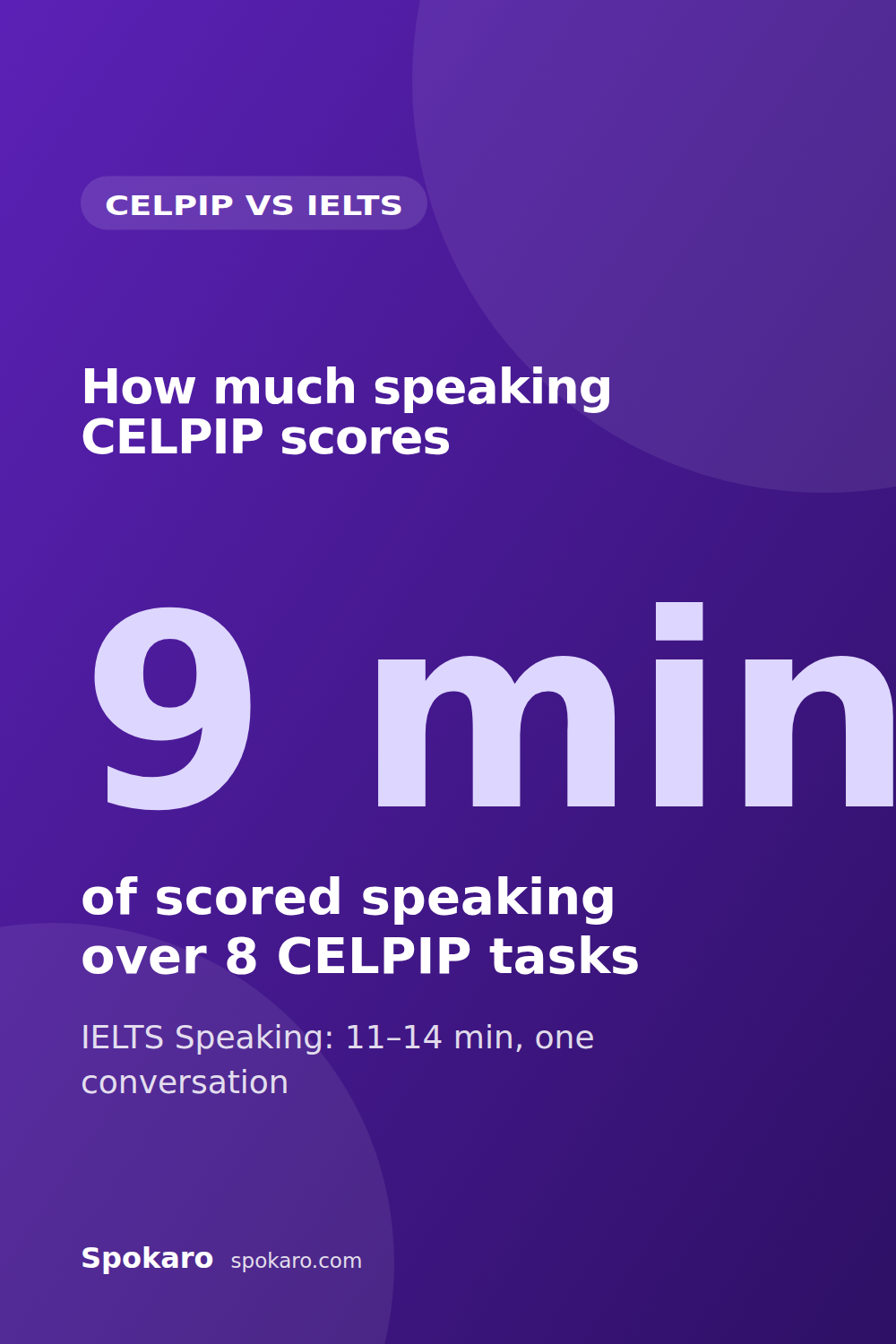
IELTS works the other way round. You talk for most of its 11 to 14 minutes, but only Part 2 is a planned monologue, and it's up to two minutes long. The rest is back-and-forth. So an IELTS examiner hears you in conversation, answering and following up, while CELPIP's raters hear eight separate short performances, each one built from nothing in half a minute.
That's why the timer is the CELPIP complaint you hear most. Eight fresh starts in a row is tiring in a way one conversation isn't. If you run out of ideas at 40 seconds in a 60-second task, the clock doesn't stop for you. Practising with the real timings matters more for CELPIP than any word list.
Thirty seconds to plan vs one minute with a pencil
In CELPIP, six of the eight scored tasks give you 30 seconds to prepare. Task 5 (Comparing and Persuading) gives you 60 seconds to pick one of two options without speaking, then another 60 seconds to prepare before you speak for 60. Task 6 (Dealing with a Difficult Situation) gives you 60 seconds to prepare. The CELPIP format page lists the tasks and levels if you want the official wording.
In IELTS there's only one planning moment: the minute before your Part 2 talk. Parts 1 and 3 are answered on the spot, the way you'd answer a coworker who asked you something in the hallway.

Say the topic is evening classes versus online courses:
- CELPIP, a Task 1 style prompt: a friend asks whether to take an evening class or an online course. You get 30 seconds to plan, then 90 seconds to advise that friend, with reasons and an example.
- IELTS, a Part 3 style question: the examiner asks whether you think online learning will replace classrooms. You answer right away, and the examiner may push back with a follow-up.
Which one is harder depends on how you think. If you need a moment to line up your ideas, CELPIP's planned tasks can feel kinder than IELTS's instant questions. If 30 seconds feels like nothing, IELTS's Part 1 small talk may be the gentler start. The fastest way to find out is to try one CELPIP-format task with the real timer and notice whether the 30 seconds felt like enough.
What the raters listen for, side by side
Both tests rate you on four things, and they overlap more than the names suggest.
| What's judged | CELPIP Speaking | IELTS Speaking |
|---|---|---|
| Ideas, order, linking words | Content/Coherence | Fluency and coherence |
| Word choice and precision | Vocabulary | Lexical resource |
| Grammar and sentence variety | Listenability | Grammatical range and accuracy |
| Pronunciation, rhythm, intonation | Listenability | Pronunciation |
| Pauses, hesitation, self-correction | Listenability | Fluency and coherence |
| Fit to the task, tone, length | Task Fulfillment | No separate criterion |
Two differences stand out. First, CELPIP bundles grammar, pronunciation and pauses into one dimension, Listenability, which the study pack sums up as how easy your response is to listen to and understand. IELTS gives grammar and pronunciation a criterion each, and it describes pronunciation as speaking in a way that can be understood without too much effort.
Second, CELPIP has a dimension IELTS doesn't: Task Fulfillment, which covers relevance, completeness, tone and length. CELPIP tasks often name the person you're talking to, like a neighbor, a friend or a manager, and your tone has to suit them. Talk to a manager like an old friend and that's a Task Fulfillment problem. IELTS has nothing like it, because the examiner is the only person you ever talk to.
In both tests, what you say and how you say it count: Listenability is one of CELPIP's four dimensions, and coherence is half of IELTS's first criterion.
The speaking score you need: CELPIP levels vs IELTS bands
Here's where the comparison gets concrete. IRCC's Express Entry language test page converts each test's speaking result to a CLB level. For CELPIP-General, the level number is the CLB number. For IELTS General Training it isn't:
| CLB level | CELPIP Speaking | IELTS Speaking |
|---|---|---|
| 10 and above | 10 or higher | 7.5 or higher |
| 9 | 9 | 7.0 |
| 8 | 8 | 6.5 |
| 7 | 7 | 6.0 |
| 6 | 6 | 5.5 |
| 5 | 5 | 5.0 |
| 4 | 4 | 4.0 |
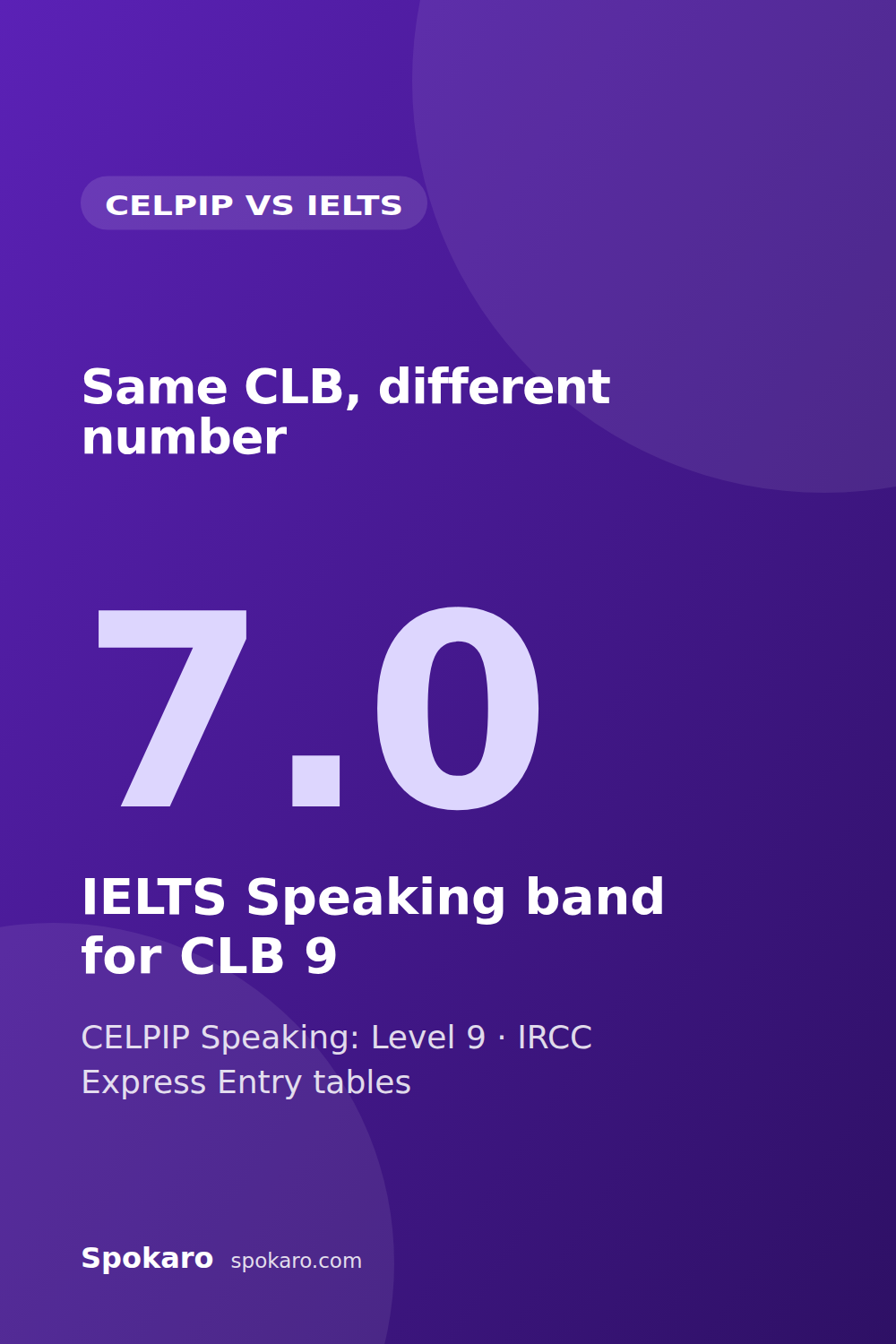
Is CELPIP 7 the same as IELTS 7? No, and it's one of the most common mix-ups. CELPIP Speaking 7 is CLB 7, which IELTS Speaking reaches at 6.0. An IELTS 7.0 in Speaking is CLB 9, the same as a CELPIP Speaking 9.
None of this makes either test easier. CLB is the shared yardstick, and the conversion is IRCC's, so there's nothing to game. What it does mean is simple: compare practice results on the CLB scale, never number to number.
Who tends to find CELPIP Speaking easier, and who doesn't
CELPIP may suit you if:
- You speak better when nobody is watching you.
- You like knowing the task types ahead of time. CELPIP's eight tasks keep the same names and order.
- You can organize an answer in 30 seconds, or you're willing to practise until you can.
- You're comfortable shifting tone for different listeners: a friend, a neighbor, a manager.
IELTS may suit you if:
- A real listener calms you down, and you enjoy conversation.
- You'd rather plan one longer talk with a minute and a pencil.
- A countdown on a screen makes you lose your thread.
- Your English sounds strongest in quick back-and-forth answers.
One practical difference, too. The British Council says IELTS Speaking may be on the same day as the other sections or up to 7 days before or after them, depending on the test centre. CELPIP-General runs all four skills in one sitting, as IDP's own comparison notes. Some people like getting it all done at once. Others would rather speak on a fresh morning.
A one-week trial to find your better format
Before you pay for either test, give each format a few days of real practice out loud. A simple week:
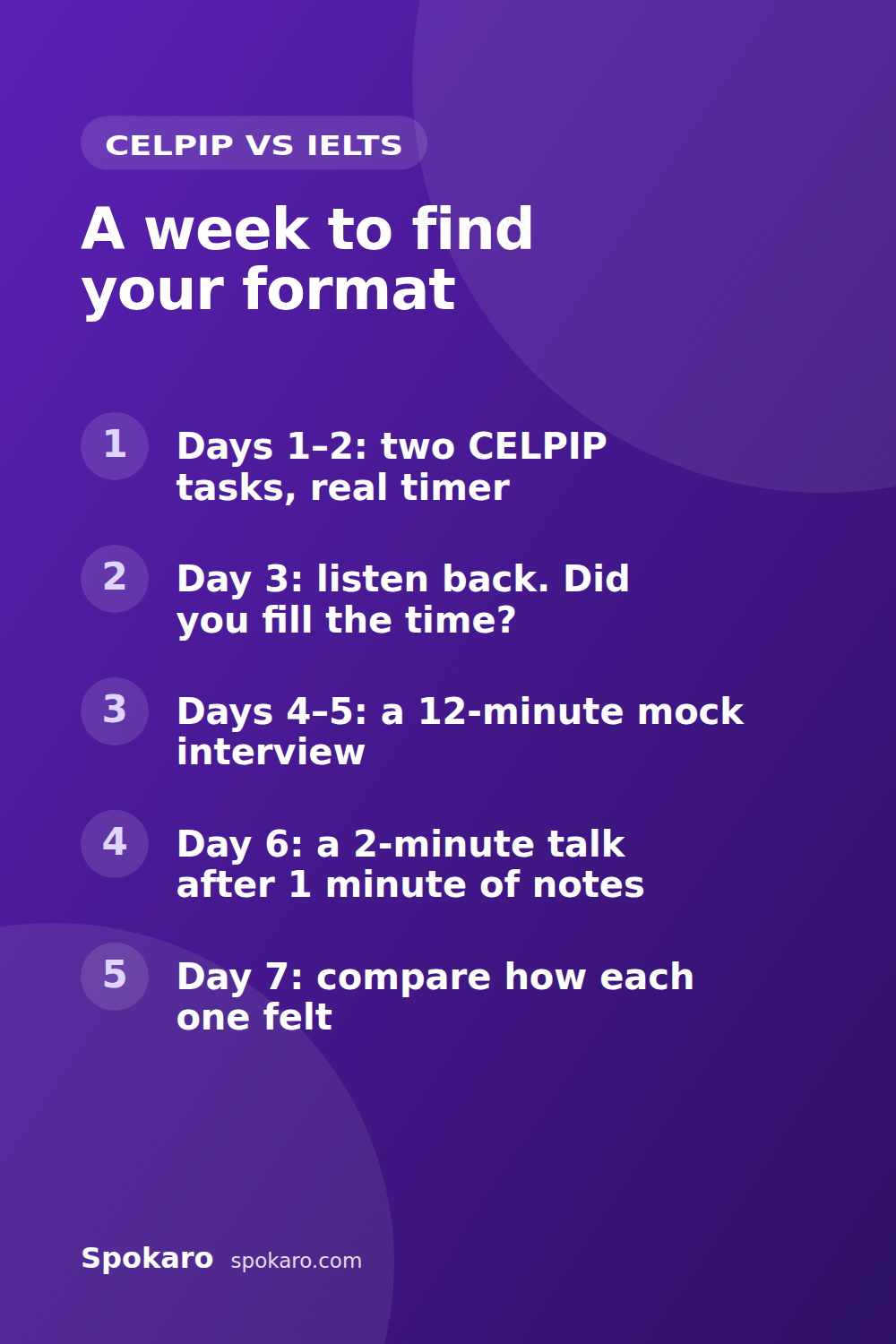
- Days 1 and 2: record two CELPIP-format tasks with the real prep and speaking times, one 60-second task and one 90-second task.
- Day 3: play them back. Did you fill the time? Did you sound rushed in the first ten seconds and empty in the last ten?
- Days 4 and 5: ask a friend to run a 12-minute mock IELTS interview: a few easy questions about your life, a Part 2 topic card, then harder follow-ups.
- Day 6: do one IELTS-style long turn on your own: one minute of notes on paper, then two minutes of talking.
- Day 7: compare how each format felt. Where did you freeze? Where did you forget the clock? That feeling is a better guide than which test your friends took.
For the CELPIP side of that week, Spokaro's practice room runs all eight tasks under the real timer, free and with no account, so you can record, listen back and hear a model answer. The free sample adds one AI estimate a day, always a range two levels wide like "about CLB 7–8", never a promise of a level. The real test is rated by people, so treat any practice estimate as a pointer to what to work on next.
Questions people ask
Is CELPIP speaking harder than IELTS?
Not on paper: IRCC accepts both for Express Entry and converts each to the same CLB levels. The difference is format. CELPIP Speaking is eight short timed tasks recorded on a computer, with 30 to 60 seconds to plan. IELTS Speaking is an 11 to 14 minute face-to-face interview, with planning time only before the Part 2 talk. Which feels harder depends on whether you do better alone with a timer or with a listener in front of you.
Is CELPIP 7 equivalent to IELTS 7?
No. For Speaking, CELPIP 7 equals CLB 7, and IELTS reaches CLB 7 at a band of 6.0. An IELTS Speaking band of 7.0 equals CLB 9, the same CLB as a CELPIP Speaking level of 9.
Which is better, CELPIP or IELTS?
For Canadian immigration, neither is better in itself: both are approved by IRCC, CELPIP-General and IELTS General Training alike. Choose by fit. If you speak more easily without someone watching and can plan quickly, CELPIP's format may suit you. If you do better in a real conversation, IELTS's interview may. Test dates and centres near you matter too.
How does a CLB 10 in CELPIP compare to an IELTS score?
For Speaking, CLB 10 is a CELPIP level of 10 or higher, or an IELTS band of 7.5 or higher. The other skills convert differently: for CLB 10, IRCC's table asks IELTS test takers for 8.5 in Listening, 8.0 in Reading and 7.5 in Writing.
Sources
- Paragon Testing Enterprises, Test Format & Scoring: the speaking tasks, the time allotted and the levels
- Paragon Testing Enterprises, CELPIP Speaking Pro: Target 9+ Study Pack (2020): each task's prep and speaking time and the four rating dimensions (archived copy)
- CELPIP, Test Results: how speaking performances are rated
- IELTS, General Training test format: Speaking (parts, timings, the four assessment criteria), read 2026-11-08
- British Council, IELTS test format: when the Speaking test is taken, read 2026-11-08
- IRCC, Express Entry: Language test results (accepted tests and the CLB tables for CELPIP-General and IELTS General Training), read 2026-11-08
- IDP IELTS, IELTS or CELPIP: which test is best (CELPIP's single sitting), read 2026-11-08
Keep reading
Is CELPIP Speaking Marked by AI? Who Really Rates Your Answers
Is CELPIP Speaking marked by AI? No: three to five trained raters score it, and only Writing uses an AI-human system. What that means for your practice.
Why Is CELPIP Speaking So Hard? What the Clock and the Rating Really Ask
Why is CELPIP Speaking so hard? Short planning time, eight different tasks and four rated areas at once. What each asks, and how to practise it.
CLB 9 in CELPIP Speaking: What Level 9 Answers Do That Level 8 Answers Don't
CLB 9 in CELPIP Speaking, read from the test maker's own rater notes: what separates its Level 8 and Level 9 sample answers, and how to practise for it.