Is CELPIP Speaking Marked by AI? Who Really Rates Your Answers
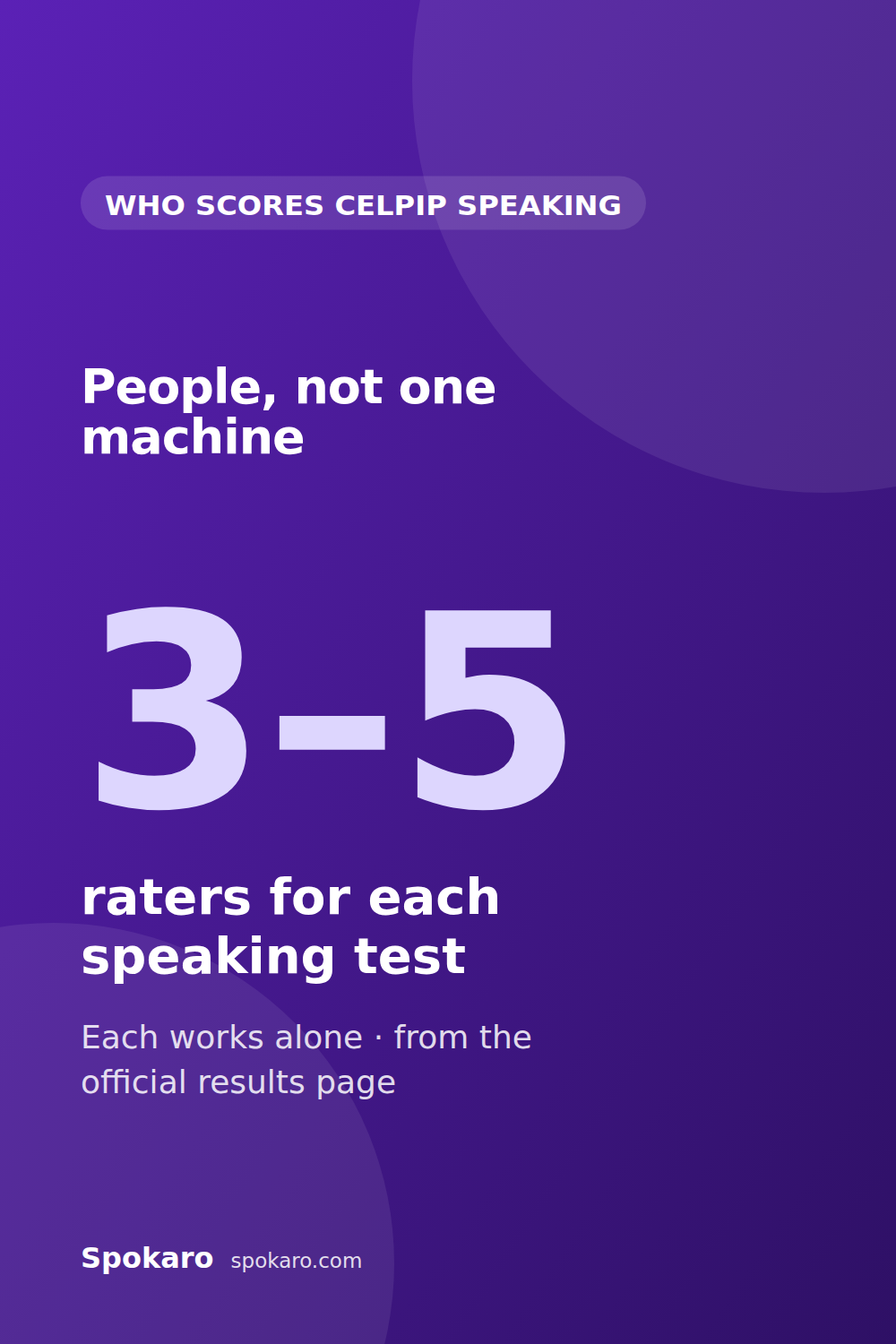
No. On the official test, your CELPIP Speaking answers are marked by people. The test's own results page says each speaking performance is rated by three to five trained raters, each working alone, none of them seeing the others' scores. The one place the test maker mentions artificial intelligence is Writing: its FAQ says the Writing Test is scored by an "AI-human hybrid system", with every writing score checked by its rating team. Speaking is not named there. The computer you sit at records your voice. People decide your level.
That matters for how you prepare, because a trained listener notices different things than a pronunciation app does. Below is what the official pages say, who the raters are, how an answer travels from your headset to a level, and where AI really does fit: in practice tools like ours, as an estimate. (Spokaro is not affiliated with Paragon Testing Enterprises, the maker of the CELPIP test.)
Is CELPIP Speaking marked by AI? The short answer
Here is the whole picture in three lines, one per kind of scoring:
- Speaking: rated by three to five human raters for each test taker, each working independently.
- Writing: rated by four to six raters, and scored by what the test maker calls an AI-human hybrid system, with every writing score reviewed by its rating team.
- Listening and Reading: computer rated. These are the multiple-choice parts, so a machine can mark them right or wrong.
So if someone in a forum tells you the speaking test is "all AI now", they are most likely mixing up Speaking with Writing. And if a practice site says its AI "marks exactly like the real test", keep in mind that the real test's speaking marks come from people. An AI can copy the rubric. It is not one of the raters.
What the test maker says about AI, word for word
The clearest statement sits in the FAQ on the CELPIP contact page. The question there is close to the one you typed into a search box: "Is my test scored by artificial intelligence?" The answer names one component only.
From the official FAQ
"The CELPIP Writing Test is scored by an AI-human hybrid system that combines artificial intelligence with our human rating panel. All CELPIP writing scores are reviewed and verified by our rating team, ensuring that your CELPIP scores are certified against our rating criteria."
Notice what is missing. The answer does not say Speaking is scored by AI, and it does not explain how the AI and the raters split the work in Writing. What we can say is that the scoring section of the results page, the one that walks through the rating procedure in detail, describes Speaking as rated by people from start to finish.
Policies change, so check the date on anything you read about this, including this post. If you are reading it months from now, open the two official pages in the sources list and read the FAQ answer yourself. It takes about a minute, and it beats any forum thread.
Who marks the CELPIP exam? The raters behind your score
The test results page lists what a CELPIP rater needs before they score anyone. In short:
- English: a native speaker of English, or a non-native speaker at CLB 11 or 12.
- Education: at least an undergraduate degree.
- Teaching or assessment background: an ESL teaching certificate recognized by TESL Canada, or graduate training in language education or linguistics, plus at least three years of experience in ESL teaching, language education or a linguistics-related field.
- Where they live: in Canada at the time of scoring.
Then comes training. New raters work through a training program with a manual, exercises and practice ratings, and they must certify before they rate real tests. After that the training keeps going: feedback on how closely they agree with other raters, sample answers rated by expert raters, and seminars where hard cases get discussed. The page also says rater performance is analyzed every month, and a rater who keeps falling short of the standard loses their rating contract.
None of that turns a rater into a machine. It makes them a trained listener held to a shared rubric, which is a different thing to prepare for. More on that below.
How is CELPIP Speaking marked, from your headset to a level
The official rating procedure has a handful of steps. Each one exists to keep a single person's opinion from deciding your score.
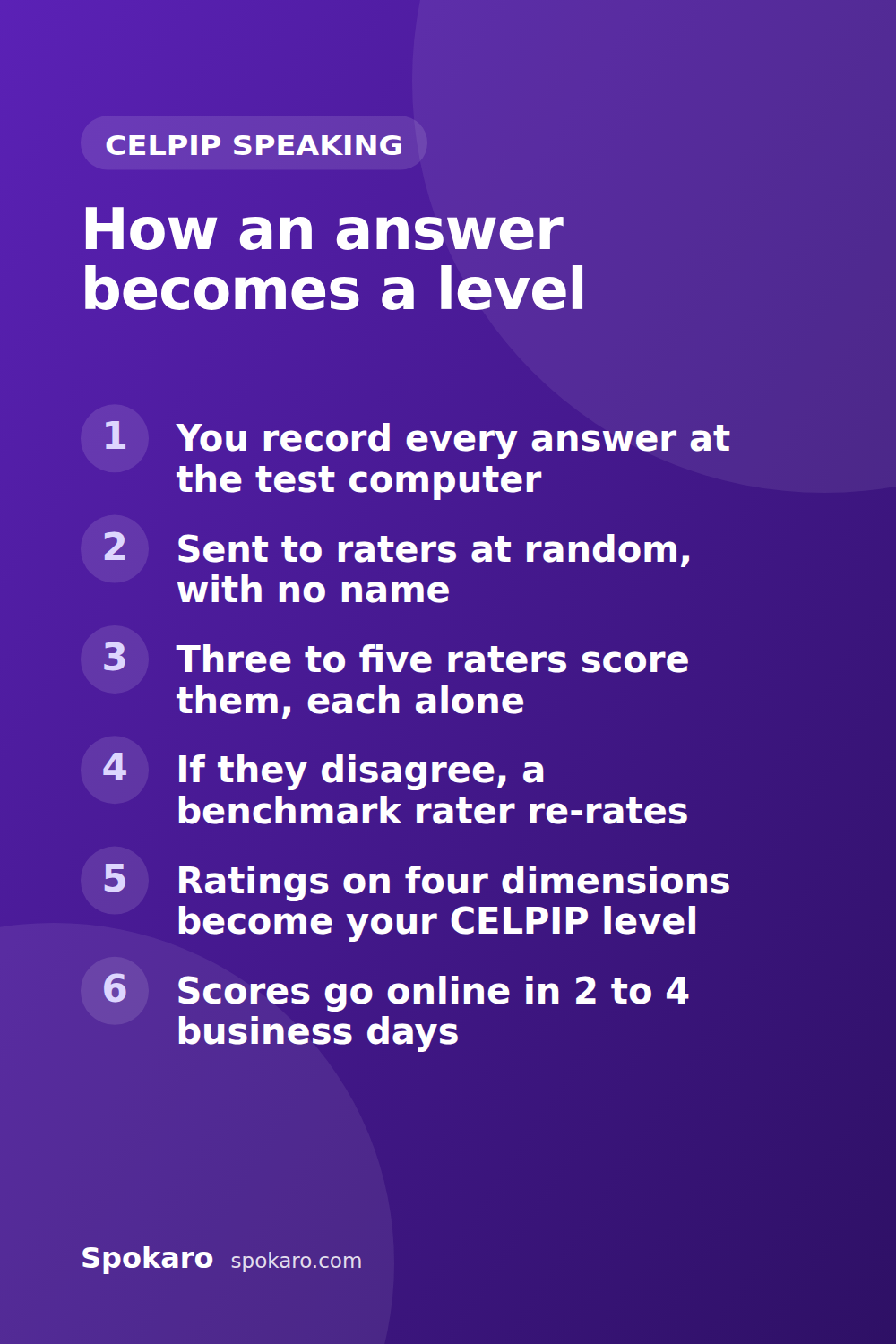
A few details are worth knowing. The raters judge your whole speaking performance, meaning your answers to all the tasks together, not one task on its own. They do not know your name, and they do not know what the other raters gave you. When the ratings are in, they are checked for agreement. If they disagree, a benchmark rater (an experienced rater with a record of consistent accuracy) is assigned automatically and rates the performance without seeing the first ratings.
The last step turns ratings into a level. The page says the speaking score is derived from the raters' ratings on each dimension and then transformed into a CELPIP level, using rules that language experts set in a standard-setting exercise. That is why your report shows a level from 0 to 12, not a count of points. The same page says your scores are available online through your CELPIP Account in 2 to 4 business days after your test date, not counting weekends or holidays.
What the raters listen for in each answer
The rubric has four dimensions, and each one is split into five performance levels with written descriptors. A rater picks a level on each dimension by finding tangible evidence in your answer that matches a descriptor. Here are the four, with the factors the official study pack lists under each:
| Dimension | What the rater weighs |
|---|---|
| Content/Coherence | Number of ideas, quality of ideas, organization of ideas, examples and supporting details |
| Vocabulary | Word choice, suitable use of words and phrases, range of words and phrases, precision and accuracy |
| Listenability | Rhythm, pronunciation and intonation; pauses, interjections and self-correction; grammar and sentence structure; variety of sentence structure |
| Task Fulfillment | Relevance, completeness, tone, length |
The phrase "tangible evidence" is the useful part. A rater cannot give you credit for an idea you meant to say. They can only score what is on the recording, so the job in each task is to put your best evidence on it, out loud, inside the time.
Why a human rater changes how you should practise
If a machine alone scored you, you might be tempted to game it: hit certain words, keep a steady speed, never pause. A trained person listening against a rubric is harder to game, and easier to win over in a more honest way. Four habits follow from that.
- Answer the task you were given. Relevance and completeness both sit under Task Fulfillment. On a picture task, talk about the picture. A fluent minute about something nearby is still off the task.
- Match your tone to the person. Tone is listed by name. Advice to a friend and an explanation to a customer should not sound the same, and a listener hears that difference at once.
- Give one real example. Examples and supporting details count under Content/Coherence. One concrete detail ("the last bus leaves at 11") is more evidence than three general sentences.
- Finish your thought. A sentence the timer cuts off leaves the rater with less to score. Aim to land your last point with a few seconds to spare.
What about memorized templates? The official pages don't mention them. But think about what a rater is doing: looking for evidence that matches the descriptors, for this task. A long canned opening that would fit any question uses up your seconds without adding much evidence for this one. A short opener in your own words, then straight to your point, usually serves you better.
One more worry people bring up: small slips. Self-correction is one of the factors under Listenability, so a rater does notice it. But it is one factor among sixteen. A quick fix and moving on sounds very different from stopping and restarting the same sentence three times.
Where AI does fit: practice tools and their estimates
AI is all over CELPIP practice, ours included, so it is fair to be plain about what it is and what it is not.
In Spokaro, when you send an answer, Microsoft Azure AI Speech writes down what you said, word for word, and measures your pronunciation, fluency and pauses. An AI model then reads that transcript beside the task and marks it on the test's four dimensions. You get an estimate as a band two levels wide, like "about CLB 7 to 8", never one exact number. All of that is spelled out on our About page, along with what happens to your recording.
A practice score like that is good for one thing above all: a quick, repeatable read on your own answers, so you can try a task, fix one thing and try again the same evening. It is not a forecast you can bank on, for a simple reason. The real test is rated by people, and no practice tool, ours or anyone's, is one of those raters. Treat any practice score from any site as a pointer to what to work on next.
If you want the whole test in one sitting, the free mock test (once per person) runs all eight scored tasks back to back under the real timer and gives a level estimate for the whole test, plus the three things to fix first. Or practise one task at a time in the practice room.
If your speaking score looks wrong: re-evaluation
Because people rate Speaking, a second look can change the result in a way it rarely does for the computer-marked parts. The official results page says you can apply for a re-evaluation of some or all components of the CELPIP-General Test within six months of your test date. It also warns that re-evaluating Listening or Reading is unlikely to change those scores, since they are computer rated.
Whether to ask is your call. Before you do, compare the level with what your timed practice has shown over the past few weeks. A level well below a steady run of practice is a better reason to ask than one task you remember going badly.
Questions people ask about CELPIP marking
How is CELPIP speaking marked?
By three to five trained human raters, each working alone, on four dimensions: Content/Coherence, Vocabulary, Listenability and Task Fulfillment. If their ratings disagree, a benchmark rater scores the performance again. The ratings are then turned into a CELPIP level from 0 to 12.
Who marks the CELPIP exam?
Qualified CELPIP raters, trained and certified by the test maker. Each needs at least an undergraduate degree, ESL or language-education training plus three years of experience, English at a native or CLB 11 to 12 level, and must live in Canada when scoring. Listening and Reading are computer rated.
How is CELPIP writing marked?
Each writing performance goes to four to six raters. The official FAQ also says the Writing Test is scored by an AI-human hybrid system, and that every writing score is reviewed and verified by the rating team.
How to crack CELPIP speaking?
There is no trick, and no one can promise a level. What helps: practise every task under the real timer (30 or 60 seconds to plan, 60 or 90 to speak), answer exactly what each task asks, give one concrete example, and record yourself so you can listen back the way a rater would.
Sources
- Contact Us and FAQs, CELPIP (Paragon Testing Enterprises): "Is my test scored by artificial intelligence?", read 2026-11-03
- CELPIP Results, CELPIP: the rating procedure, rater qualifications and training, benchmarking, re-evaluation, read 2026-11-03
- Test Format & Scoring, CELPIP: the eight speaking tasks and the levels
- CELPIP Speaking Pro: Target 9+ Study Pack (2020), Paragon Testing Enterprises: the task timings and the four rating dimensions
Keep reading
Why Is CELPIP Speaking So Hard? What the Clock and the Rating Really Ask
Why is CELPIP Speaking so hard? Short planning time, eight different tasks and four rated areas at once. What each asks, and how to practise it.
Is CELPIP Speaking Harder Than IELTS? What Changes for the Speaker
Is CELPIP Speaking harder than IELTS? Neither is harder on paper. What changes for you: the format, the timer, what raters judge and the band you need.
CLB 9 in CELPIP Speaking: What Level 9 Answers Do That Level 8 Answers Don't
CLB 9 in CELPIP Speaking, read from the test maker's own rater notes: what separates its Level 8 and Level 9 sample answers, and how to practise for it.