Speaking tasks
CELPIP Speaking Template: 8 Answer Shapes Built From the Official Rater Notes

A good CELPIP speaking template is an order of moves for each task, not a script to memorise. The test maker's own speaking study pack never uses the word “template”. What it gives instead is a short list of key strategies for every task, plus rater notes on real sample answers. Those notes show what scripted lines cost: an introduction marked “too long and unclear”, a “The first one is” with no second reason after it, a “Thank you” that didn't fit the moment. Below are eight answer shapes built from those strategies, one per task, with the traps the notes point at.
Spokaro is not affiliated with Paragon Testing Enterprises, the maker of the CELPIP test.
What a CELPIP speaking template should be: the short answer
Think of a template as the order you say things in, not the words you say. The prompts change every test. The task types don't. So the part worth deciding before test day is the shape: what comes first, how many ideas, where the details go, how you end.
Here's the difference in practice. A script for Task 3 might open with a long, polished sentence about how interesting the picture is. A shape for Task 3 says: one line on the place, then three or four people, then stop. The script only works if you remember it word for word and it happens to fit the picture. The shape works for any picture, and it leaves your head free for what raters actually listen to, which is what you see and how you say it.
Page one of a search for this topic is mostly fill-in-the-blank PDFs, flashcards and prep sites. Some are careful. One promises templates that score 12 every time, which no template can do, because people rate the answers (we covered who they are in our post on how CELPIP Speaking is marked). At least one lists the wrong prep or speaking time for several tasks. So check any template's timings against the official table below before you build a habit on it.
What the official rater notes say a scripted line costs
The study pack has two sample answers for each of the eight tasks, rated from Level 8 to Level 12, with a short list of notes under each. Read those notes with templates in mind and a pattern shows up. Many of the weak points sit at the edges of an answer, the exact spots where a memorised line usually goes:
- A long opening. A Task 1 answer rated Level 9 still got the note “introduction too long and unclear”. The rest of it was strong.
- A signpost with nothing behind it. A Task 7 answer rated Level 8 used “The first one is” and, in the notes' words, “introduces no further reasons”. The opening promised a list. The answer never gave one.
- A closing that doesn't fit. A Level 8 Task 6 answer ended with “Thank you”, and the note calls it “awkward for this context”. It was a tough talk with a coworker, not a speech.
- Talking to nobody. Two Task 3 answers, a Level 9 and a Level 8, were noted for not addressing another person directly. A Level 9 Task 6 answer didn't speak to the customers the task named.
- No closing at all. One note on a Level 8 Task 8 answer, in full: “No closing”.
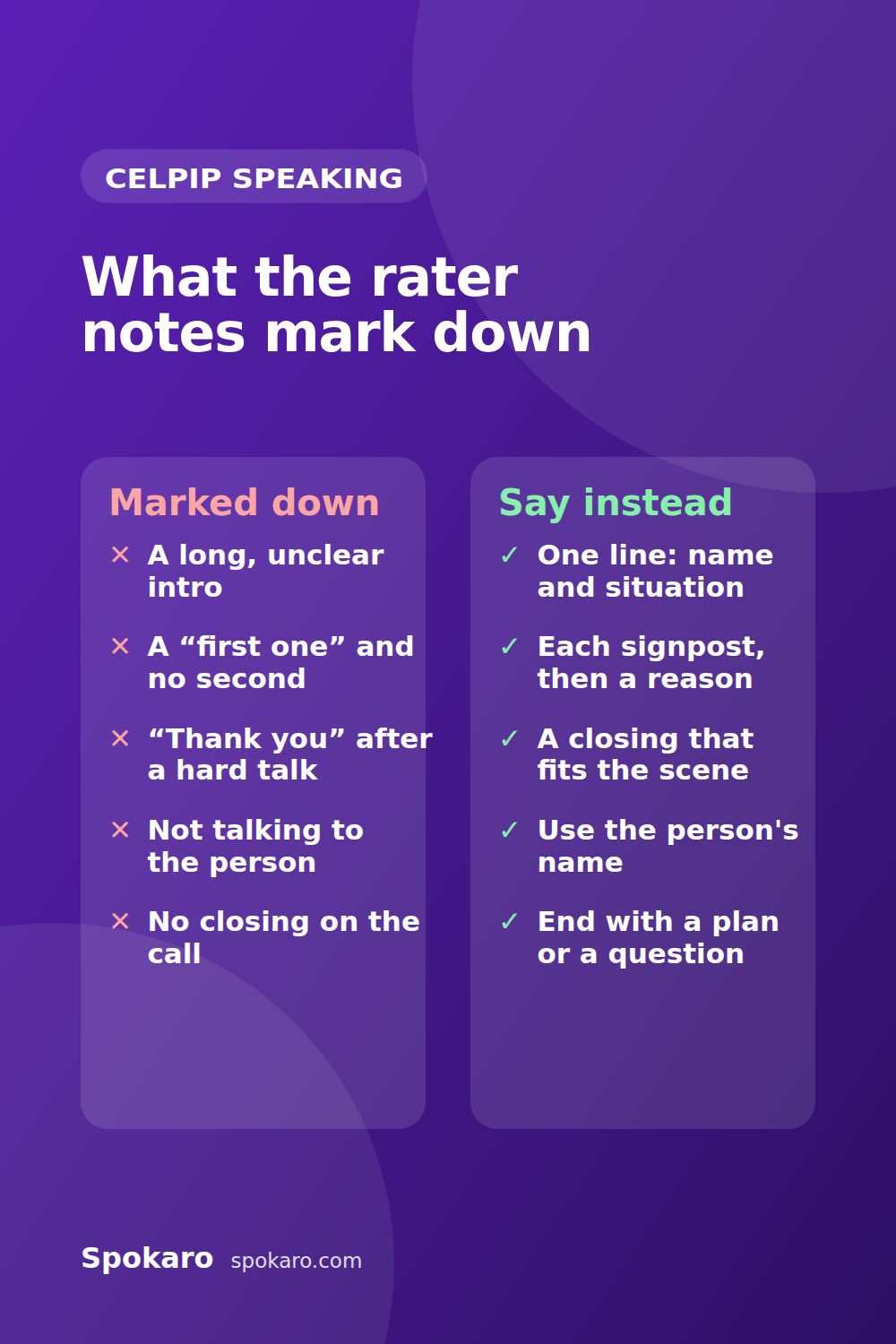
The other side of the notes is just as useful. The one Level 12 answer in the pack, a Task 4 prediction, is praised for including “an opening and a closing” and for using several ways of talking about the future. And a Task 3 answer was rated Level 9 even though its final idea was cut off. So a template doesn't need a grand opener or a long wrap-up. It needs a short, real first line and a closing that fits the person you're talking to.
How many words a 60-second answer holds
The 16 sample answers in the study pack show how much fits, ums and uhs included. The answers to the 60-second tasks run from 102 to 179 words. The answers to the two 90-second tasks (Tasks 1 and 7) run from 139 to 245.
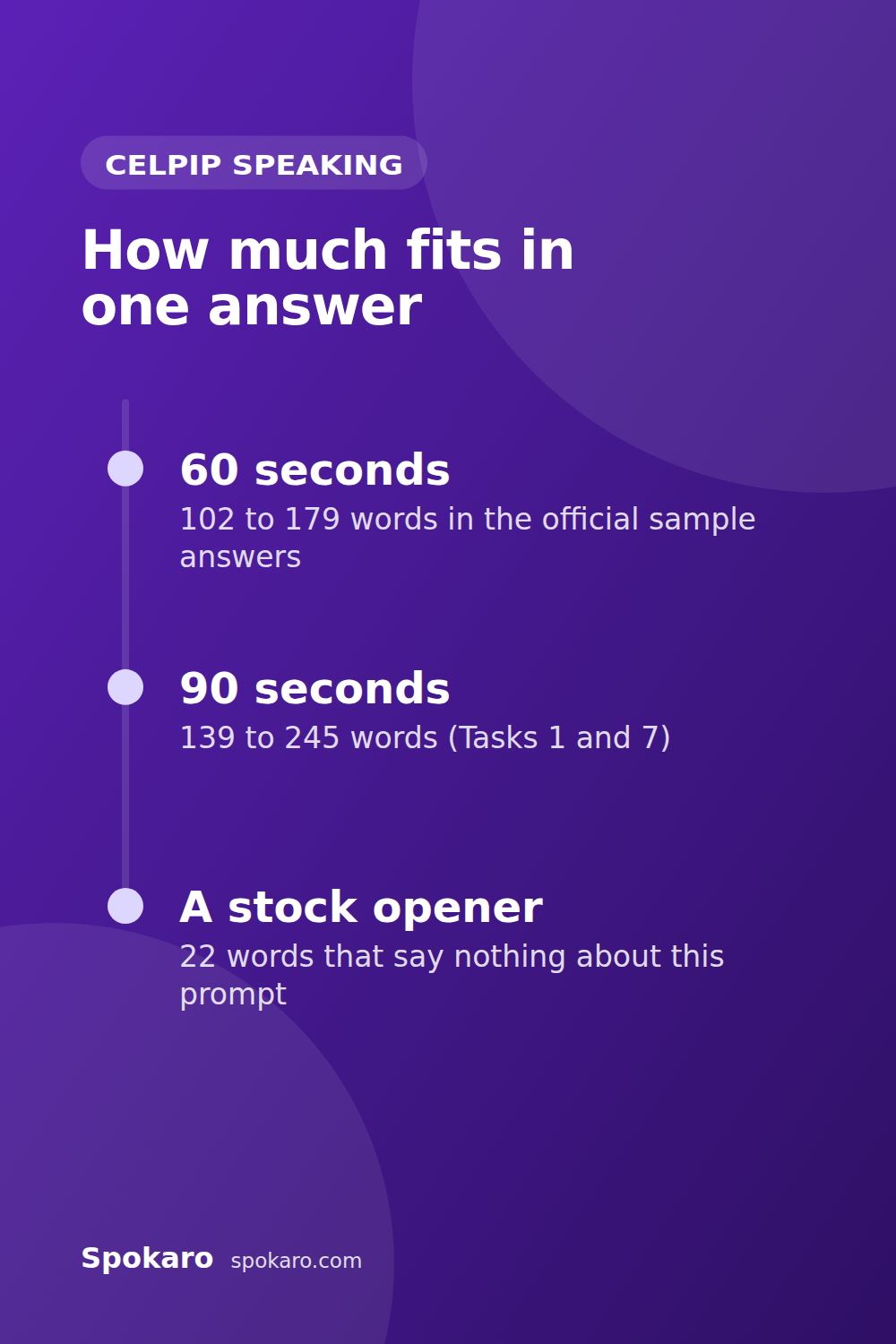
Now take a stock opener of the kind template PDFs hand out: “Thank you for this question. Today I would like to describe the picture which shows a very interesting scene with many people.” That's 22 words. In a 102-word answer it's more than a fifth of your minute. In a 179-word answer it's still about one word in eight. And it says nothing about the picture.
Raters weigh the number, quality and organization of your ideas under Content/Coherence, and relevance, completeness, tone and length under Task Fulfillment. A sentence that could open any answer adds to neither. Spend your first five seconds on something that belongs to this prompt only, and the shape has already earned its keep.
| Task | Prep | Speak |
|---|---|---|
| 1 · Giving Advice | 30 s | 90 s |
| 2 · Talking about a Personal Experience | 30 s | 60 s |
| 3 · Describing a Scene | 30 s | 60 s |
| 4 · Making Predictions | 30 s | 60 s |
| 5 · Comparing and Persuading | 60 s to choose, then 60 s | 60 s |
| 6 · Dealing with a Difficult Situation | 60 s | 60 s |
| 7 · Expressing Opinions | 30 s | 90 s |
| 8 · Describing an Unusual Situation | 30 s | 60 s |
The prep and speaking times are the study pack's. Task 5's first minute is for choosing only: you don't speak in it. The whole speaking test takes about 15 to 20 minutes. Each task's shape, move by move, is in its section below.
Template for Task 1 and Task 2: advice and a story
Task 1, Giving Advice (30 seconds to prepare, 90 to speak). The pack's key strategies: speak directly to the person, give at least three suggestions, back each one with a practical example or reason, signal each new one with a transition, and sound helpful.
- The person and the situation, in one sentence. “Hey Priya, so the move to Saskatoon is finally happening.” Ten seconds, not thirty.
- Suggestion one, with why. A reason and one concrete detail: what to buy, where to go, what it costs.
- Suggestion two, with a fresh transition. “Another thing that'd really help is…”
- Suggestion three. Shorter is fine if the clock is tight.
- A close that fits a friend. “Text me once you've found a place.”
Three suggestions in 90 seconds is about 25 seconds each, room for one reason and one example. The Level 8 Task 1 sample gave details for its first idea and not for the others, and the notes say so. Plan all three in your 30 seconds, then give each its reason as you go. You can try Task 1 under the real timer in the practice room.
Task 2, Talking about a Personal Experience (30 and 60). The strategies: decide quickly what story to tell, and if no real one comes to mind, the pack says you can make one up. Use past tenses, add descriptive details, and try to make the listener feel what you felt.
- When and where. “Two winters ago, in my first week at a new job…”
- What happened, in order. Three or four past-tense sentences: first, then, after that.
- The moment it turned. One sharp detail and how you felt.
- How it ended, in one sentence.
The trap in Task 2 isn't the opening. It's the hunt for a story. Spend 20 of your 30 prep seconds searching your memory and there's nothing left for planning. Keep three all-purpose stories in mind (a time you helped someone, a time something went wrong, a time you learned a skill) and bend one to fit the prompt.
Template for Tasks 3 and 4: the picture tasks
Task 3, Describing a Scene (30 and 60). The pack's strategies: start with a general statement, then focus on some details (you don't need to describe everything), build a picture with descriptive words, and describe the people's appearance, actions and feelings.
- The place, in one line, to your listener. “Okay, so this is a busy bus station on a rainy morning.”
- Three or four people or groups, moving through the picture the same way every time, left to right or front to back. For each one: what they look like, what they're doing, how they seem to feel.
- Stop when the time stops. No summary needed.
Moving through the picture in the same direction every time is what saves you from freezing on “what now?”. It's a habit you can drill with any photo on your phone. The Level 9 Task 3 sample opens with the size of the place and a rough head count, then works through the people. Its final idea was cut off, and it still reached Level 9.
Task 4, Making Predictions (30 and 60) uses the same picture. The strategies: use your imagination but stay realistic, tie each prediction to what the people are doing, think about their next actions and how they'll feel, and use the people and objects around them for ideas.
- One line back to the scene. “In a few minutes, a lot of this is going to change.”
- Three predictions, each tied to a clue you can point at. “The man with the umbrella keeps checking his watch, so he's probably going to run for the next bus.”
- A short close. “So five minutes from now, this platform will look pretty different.”
Mix the ways you talk about the future: will, going to, might, probably, I'd guess. The Level 12 sample is noted for a very wide range of grammar, “including different future constructions”, and for having both an opening and a closing.
Template for Tasks 5 and 6: pick a side, then talk to a person
Task 5, Comparing and Persuading. In Part 1 you get 60 seconds to choose between two options, and you don't speak. In Part 2 you get 60 seconds to read a third option that someone else prefers and plan, then 60 seconds to persuade them yours is better. The strategies: compare the information you're given, choose quickly, then use specific language that goes beyond what's printed with the picture.
- Your pick against theirs, in one line, to them. “I get why you like that one, but I really think mine makes more sense for us.”
- Reason one, from a fact in your option's description, then what it means for them.
- Reason two, a straight comparison with a weak point in their option.
- One line asking them to agree. “So, can we go with mine?”
Pick fast in Part 1, then spend what's left of that minute finding the facts you'll turn into reasons. The Level 8 Task 5 sample gave three main ideas and was told that more examples and details would improve it. The Level 9 one was praised for connecting and developing its ideas.
Task 6, Dealing with a Difficult Situation (60 and 60). You get two choices and speak to the person your choice involves. The strategies: speak directly to that person, be considerate but firm, stay respectful, outline the problem clearly, explain your decision and back it with good reasons.
- Their name and the problem, calmly. “Jordan, I need to talk to you about the rent.”
- Your decision, said plainly.
- Two or three reasons.
- What happens next: an offer, a deadline or a compromise.
Save “Thank you” for a speech. The Level 8 Task 6 sample ended on it, and the note calls it awkward for that context. The Level 9 sample was noted for not speaking directly to the customers the task named. Both slips come from a habit, not from weak English, which makes them the easiest to fix. Practise Task 6 with both choices.
Template for Task 7 and Task 8: an opinion and a phone call
Task 7, Expressing Opinions (30 and 90). The strategies: read the question carefully and stay on topic, decide yes or no quickly, give about three reasons, support each with specific details, and use transitions to signal new ideas.
- Your answer, in the question's own key words.
- Reason one, with an example.
- Reason two, with an example.
- Reason three, with an example, or a quick look at the other side and why it doesn't change your mind.
- One line back to your answer.
This is where a “first, second, third” template bites. Say “The first reason is” and your listener now waits for a second. The Level 8 sample said almost exactly that, gave one reason, then drifted toward the other side, and the notes flag both: the missing reasons and the contradiction. If you're not sure you'll reach three, use signposts that don't promise a count: “One big reason is…”, “On top of that…”, “And honestly…”.
Task 8, Describing an Unusual Situation (30 and 60). You describe an odd object or scene to someone on the phone who can't see it. The strategies: set up the role-play with a greeting, describe what's unusual, stick to what you can describe well, build phrases from common words when the exact word won't come, and finish the call.
- Greeting and why you're calling. “Hi Dana, it's me. I'm at the store and I found something you need to hear about.”
- Size, shape, colour, what it's made of, what it seems to do. Compare it with things they know: “about as big as a suitcase”.
- The odd detail, the thing that makes it unusual.
- End the call with a question or a plan: “Should I get it? Call me back.”
Step four is the one people drop when the clock gets tight, and “No closing” is one of the notes on a Level 8 sample, in two words. Keep a five-second ending ready for this task and say it before the time runs out, even if the description isn't finished.
How to practise a template so it stops sounding memorised
The study pack's own practice advice is better than any template, and it fits in about half an hour a day:
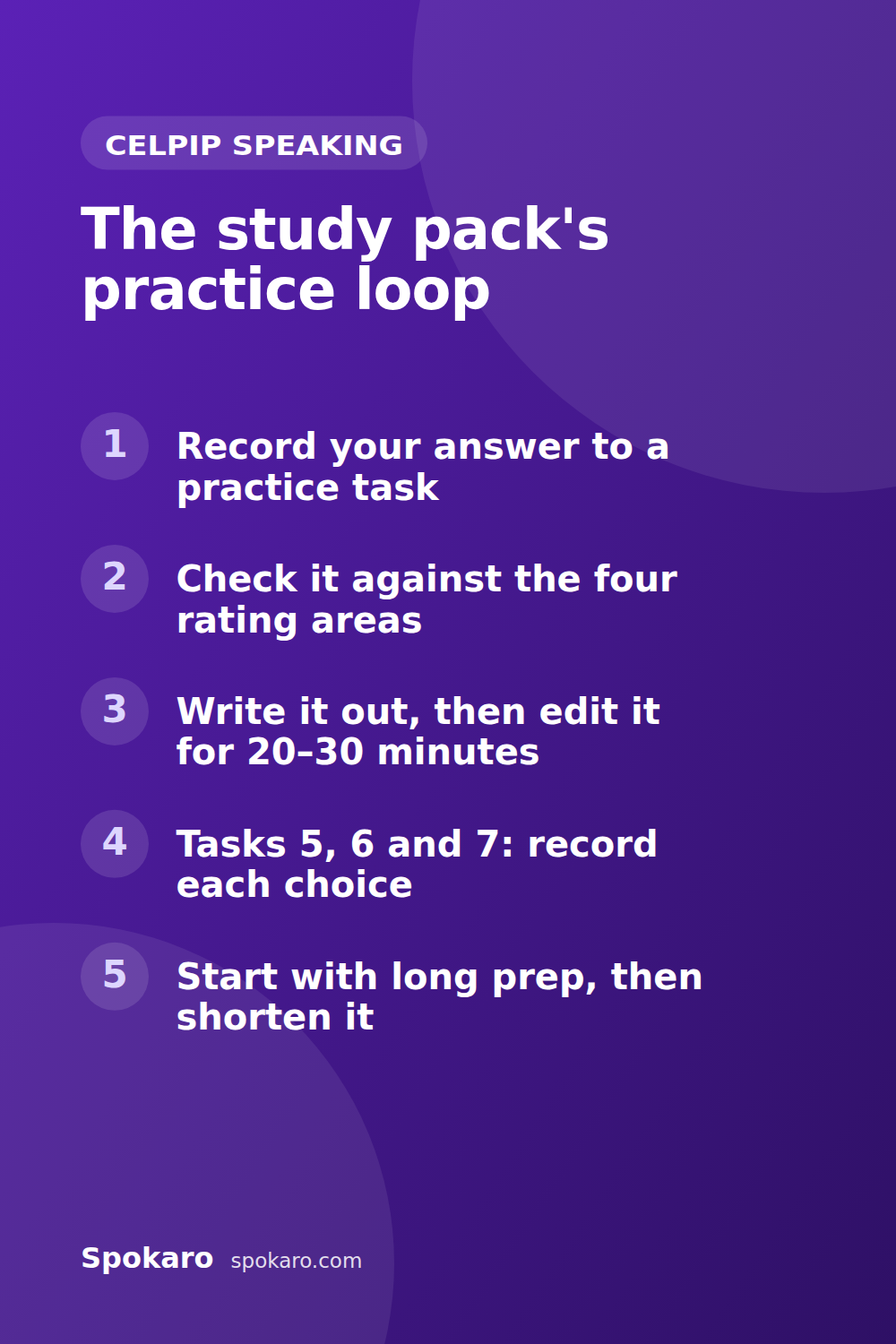
The editing step is where a template turns into your own way of talking. The pack lists the edits to make on your transcript: correct the grammar, add strong transitions, vary the vocabulary, add specific details, build some more complex sentences. You can't revise like that on test day, of course. But the next time you speak, those words come out on their own, because you chose them rather than memorised them.
Two more of the pack's ideas get far less attention than they deserve. For the tasks with a choice (5, 6 and 7), record an answer for each side, so you're never stuck with the option you like less. And give yourself more prep time than the test does at first, then cut it down week by week until 30 seconds feels like enough.
You can run this whole loop in Spokaro's practice room: every task with the test's own prep and speaking times, recorded in your browser, free and with no account. When the shapes start to feel natural, try the free mock test, which runs the scored tasks back to back and gives a level estimate. It's an estimate of how your answers read, never your CELPIP result.
Pick one task this week. Build its shape, then record it three times with three different prompts. Once the order of moves stops needing any thought, your 30 seconds of prep can go to the prompt in front of you.
Sources
- CELPIP Speaking Pro: Target 9+ Study Pack (2020), Paragon Testing Enterprises: the task times, key strategies, performance standards, sample transcripts and rater notes, read 2026-11-06
- The same study pack, the Internet Archive's copy of 2025-08-20 (the one read today: the original sits behind a browser check)
Keep reading
Is CELPIP Speaking Marked by AI? Who Really Rates Your Answers
Is CELPIP Speaking marked by AI? No: three to five trained raters score it, and only Writing uses an AI-human system. What that means for your practice.
Why Is CELPIP Speaking So Hard? What the Clock and the Rating Really Ask
Why is CELPIP Speaking so hard? Short planning time, eight different tasks and four rated areas at once. What each asks, and how to practise it.
Is CELPIP Speaking Harder Than IELTS? What Changes for the Speaker
Is CELPIP Speaking harder than IELTS? Neither is harder on paper. What changes for you: the format, the timer, what raters judge and the band you need.